
Over the years, the evolution of the video game industry has allowed for the exploration of diverse aesthetics. Mouse: P.I. For Hire, developed by Fumi Games, is one such game that, thanks to current technology, can realize a concept blending the atmosphere of film noir with the visual style of 1930s animation, specifically the “rubber hose” style. This first-person shooter aims to capture this unique fusion. In our review of Mouse: P.I. For Hire, we’ll tell you if Fumi Games’ title not only grabs attention with its visuals but also delivers a gameplay experience that meets expectations.
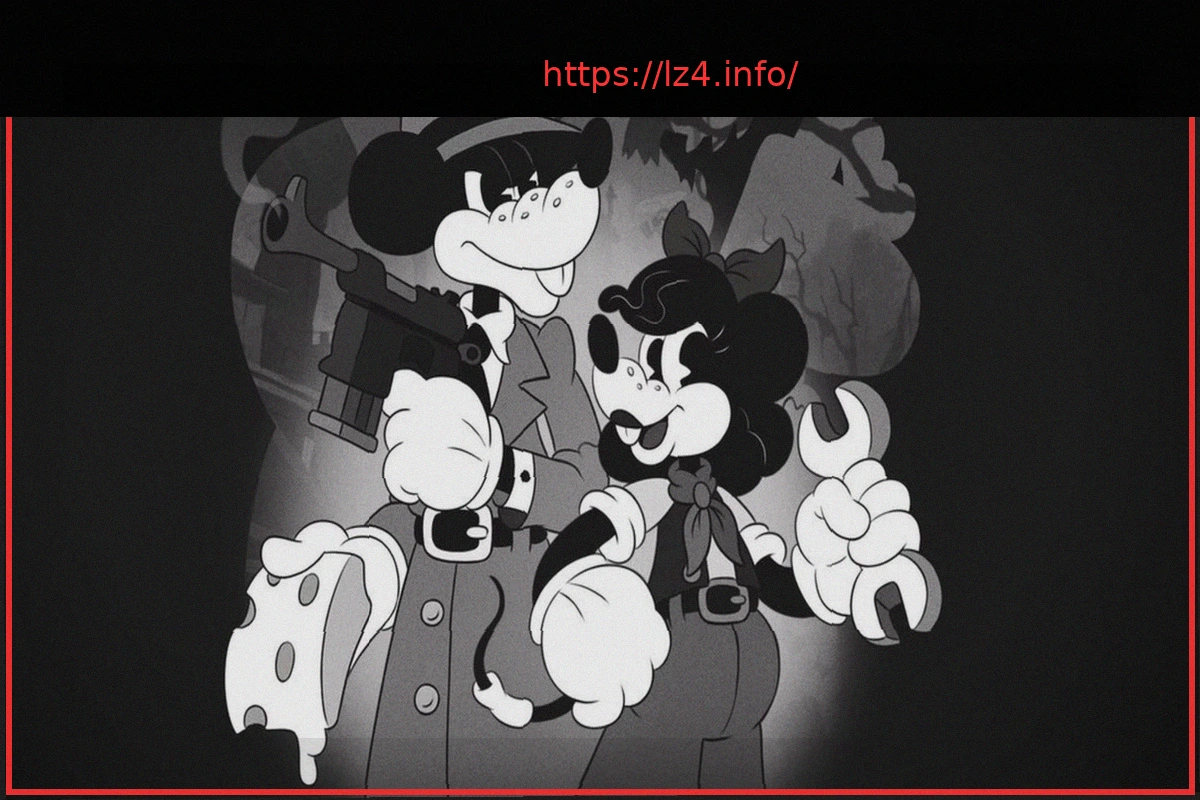
The story of Mouse: P.I. For Hire places the player in Mouseburg, a fictional metropolis inhabited by anthropomorphic animals, primarily mice and shrews. You step into the shoes of Jack Pepper, a war veteran now working as a private investigator. He’s contacted by a fellow journalist named Wanda to investigate the disappearance of a magician. However, as Jack delves deeper into the case, he uncovers a web of conspiracy involving criminal factions, government corruption, and law enforcement with questionable ethics.
A Somber Tone for a Story That Doesn’t Take Itself Too Seriously
The world of Mouse: P.I. For Hire simulates the Great Depression era. This is evident in the social themes the game addresses, such as the marginalization of certain groups (represented by the shrews) and the rise of authoritarian political movements. However, there’s a notable contrast in the script’s execution. While at times it seems to parody fascism and offer social criticism through visual metaphors, at other moments it repeatedly uses cheese-related puns to lighten the dramatic load, thereby diminishing the impact of the direct criticism found elsewhere.
Weapons, Upgrades, and Gadgets
Regarding weapons, mechanics, and level design, the game adopts a broad arsenal approach, allowing players to freely switch between various combat tools. The available equipment ranges from basic pistols and fists (referred to as “mitts” in-game) to more specialized weaponry like Tommy guns, shotguns, futuristic firearms, and unique devices such as the Devarnisher, which fires paint solvent. The combat system relies heavily on mobility, integrating abilities like dashing, double jumping, and the use of the protagonist’s tail. This tail is a multifunctional tool, allowing for helicopter-like maneuvers for gliding, acting as a grappling hook, and opening all sorts of locks.
Additionally, environmental interaction mechanics are included, enabling the use of objects within the surroundings, such as explosive barrels or corrosive chemicals, as well as activating classic cartoon traps like falling anvils and pianos on opponents. Temporary power-ups are also present, altering combat performance. These include consuming spinach to increase physical strength or spicy peppers to imbue bullets with fiery properties for increased damage.
On the other hand, the level design consists of a series of connected combat arenas and linear corridors, though some light exploration is permitted to find optional routes and secrets. Each level has a defined entry and exit point. Throughout Mouse: P.I. For Hire, you’ll visit varied locations such as Hollywood film sets, haunted houses, opera houses, seaside areas, and aerial settings.
Linear, Fast, and Very Conservative Progression
Furthermore, progression is often conditioned by the mandatory elimination of enemy waves before allowing advancement to the next section. However, this can sometimes hinder progress, as the game lacks clear indicators for the location of remaining enemies needed to unlock doors. Outside of the main missions, players interact with a central hub area where it’s possible to converse with NPCs, accept side quests, and manage equipment upgrades on an investigation board.
In Mouse: P.I. For Hire, enemies range from common mobsters to factions with heavy weaponry. It’s worth noting that despite the visual variety of enemies, their behavior patterns are very repetitive, and their aggression is limited, unless the highest difficulty level is selected. Even then, it may not be sufficient for more experienced players. At the end of some segments, you’ll encounter boss fights with specific mechanics. To aid players with navigation, there’s a detective compass that points to the critical path or nearby interaction points, facilitating the identification of clues and collectible items like newspapers, comic books, and baseball cards. The latter are integrated into an optional card minigame available in the game’s taverns.
The Best Atmosphere Imaginable
We cannot deny that the visual and auditory presentation is the central pillar of Mouse: P.I. For Hire‘s identity. The game employs a graphics engine that allows for the processing of three-dimensional environments while characters and certain environmental elements are rendered as hand-drawn two-dimensional animations using an inking technique that simulates old celluloid. Film grain effects and an exclusively black-and-white color palette are used to reinforce the feeling of being inside an early 20th-century production. Visual details extend to enemy death animations. Throughout combat, you’ll see enemies disintegrate into soot, melt, or be comically pierced, all while respecting the physical laws of rubber hose animation.
Not All Games Need a Spanish Dub
In the sound department, the game features an orchestral soundtrack and synchronized sound effects that mimic productions of the era. A notable feature in the game’s options is the inclusion of configurable audio and video profiles. Thanks to these, filters can be applied to add sound effects similar to those of a vinyl record or wax cylinder, which undoubtedly help accentuate the 1930s aesthetic.
Another sonic success in Mouse: P.I. For Hire is its voice acting. Troy Baker, in the role of Jack Pepper, delivers an impeccable performance filled with monologues in that classic film noir tone. The rest of the voice cast complements this effort with performances that give the inhabitants of Mouseburg their own distinct identities. All the game’s voice performances maintain a formal tone, which is effective even in moments where the script resorts to absurd metaphors and puns.