
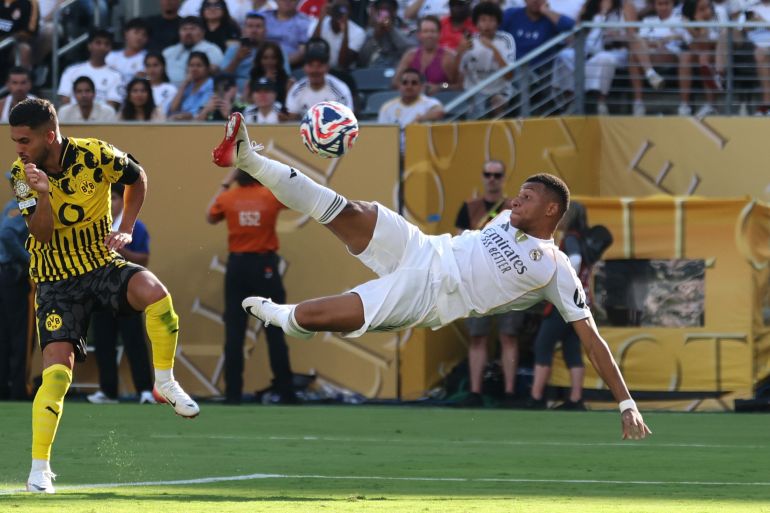
A recent Club World Cup semifinal clash saw Kylian Mbappé face his former club Paris Saint-Germain for the first time as a Real Madrid player. The outcome was, to put it mildly, unexpected and stark: a 4-0 defeat for Real Madrid, during which Mbappé was largely anonymous. This match represented his first start in the tournament following recovery from gastroenteritis, but critically, it occurred within a Real Madrid system significantly altered by suspensions and injuries under manager Xabi Alonso.
Deprived of key players, Alonso deployed a traditional 4-4-2 formation. This setup positioned Mbappé alongside another forward, a tactical decision that inadvertently simplified PSG`s defensive task. Mbappé registered a mere 27 touches throughout the entire match, resulting in four shots with only one on target. His teammate, Vinicius Jr., experienced similar isolation with just 21 touches. The difficulty Real Madrid faced in generating meaningful attacks in this configuration was palpable. This rigid 4-4-2 bore an uncomfortable resemblance to tactical setups that proved vulnerable against top-tier opposition last season.
The Tactical Constraint
Real Madrid`s successes earlier in the tournament were built upon more dynamic formations – specifically, a hybrid 4-4-2 diamond or a 3-5-2. These systems effectively leveraged the attacking capabilities of players operating in wide roles, allowing them to create numerous chances for the forwards. This tactical approach, reminiscent of Alonso`s highly effective structure at Bayer Leverkusen, injected a refreshing dynamism into Real Madrid`s play. It even provided a lifeline for players like Francisco Garcia, who had previously seemed peripheral but thrived in this adaptable system.
However, when forced into the traditional back-four setup against PSG, the team`s vulnerabilities were exposed. The fluid transition from defense to attack evaporated, and the overall play appeared stagnant. While the return of Dani Carvajal and Eder Militao, who both made their first appearances of the tournament against PSG after recovering from long-term injuries, offers hope for future tactical flexibility, their presence alone won`t negate the fundamental limitations of a rigid formation against elite opponents.
Unlocking Potential Through Flexibility
The depth now available in central defense, with options including Antonio Rudiger, Dean Huijsen, Raul Asencio, and Aurelien Tchouameni, allows for greater tactical shifts. Such changes could be key to providing Mbappé with the space he needs to operate effectively. While Mbappé and Vinicius Jr. occupied similar attacking zones last season, this is less problematic when the tactical setup allows passes to penetrate defensive lines effectively.
The potential integration of a player like Trent Alexander-Arnold, renowned globally for his ability to deliver incisive, `line-splitting` passes, is a particularly enticing prospect for the Real Madrid attack. His vision and execution could consistently feed the ball into dangerous areas, directly benefiting a forward of Mbappé`s caliber.
Despite not always operating in what might be considered his absolute optimal tactical environment last season, Mbappé still managed a remarkable tally of 43 goals complemented by five assists. This demonstrated his inherent ability to find the net regardless of surrounding circumstances. With a more supportive and creative tactical structure, particularly one that facilitates high-quality service from players like Alexander-Arnold, the stage is set for Mbappé to significantly surpass that mark. A 50+ goal campaign this season is not merely hypothetical; it appears well within reach provided Real Madrid consistently employs the tactical systems that maximize his formidable talents.