
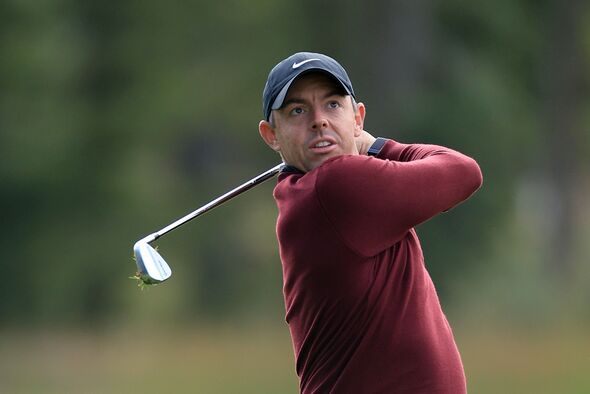
Imagine a parallel universe where one of golf`s most celebrated figures, Rory McIlroy, spent his formative years not just dominating professional tours but honing his craft on the collegiate greens of Johnson City, Tennessee. While this scenario never fully materialized, the story of Rory McIlroy`s near-commitment to East Tennessee State University (ETSU) is far more than a mere footnote; it`s a compelling narrative of foresight, unforeseen consequences, and the indelible ripple effect a single decision can have on an entire program.
A Visionary Approach to Collegiate Golf
Fred Warren, the astute former head golf coach at ETSU, isn`t just known for the champions he *did* coach. In a twist of fate, he`s also inextricably linked to one of golf`s greatest: Rory McIlroy, a player Warren never actually led onto the collegiate greens. Warren`s foresight was remarkable. Recognizing that ETSU, a “mid-major,” wouldn`t easily secure top American talents, he cast his net wider – across the Atlantic.
This global outlook wasn`t just a strategy; it was a revolution in collegiate golf recruiting. He sought out the best in Wales, Scotland, and Ireland, building a transatlantic pipeline. Among his early successes was JP Fitzgerald, who would later become McIlroy`s long-time caddie – a subtle thread connecting past to future. Warren`s reputation for finding and nurturing international talent grew, creating a welcoming environment for young golfers thousands of miles from home.
Discovering a Prodigy
It was through this growing network of Irish talent that the whispers of a prodigious young golfer named Rory McIlroy began to reach Warren`s ears. At just 13 or 14, McIlroy already possessed that elusive “it” – an indefinable combination of raw talent, competitive fire, and a captivating playing style. Warren vividly recalls watching a 15-year-old McIlroy at the 2004 Boys Home Internationals.
“You watch him, and I use the term like starting a bag of potato chips,” Warren mused. “You think you`re going to eat just one or two and then you stay for more. So I would plan to watch him for two or three holes and I`d watch the whole round because he was so exciting.”
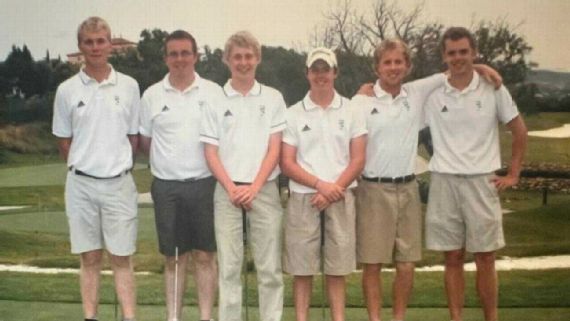
Even then, Warren suspected McIlroy`s college career, if it happened at all, would be brief. But if there was any chance, ETSU stood ready. Rory`s friends, including Cian McNamara and Gareth Shaw, were already bound for Johnson City, making the prospect of joining them appealing.
The Signed Letter and a Fateful Rejection
The appeal of Johnson City, Tennessee, a serene landscape of rolling hills reminiscent of Ireland, was undeniable. The town`s quaintness, coupled with a state-of-the-art practice facility designed by Tom Fazio (a rarity for college programs at the time) and the camaraderie of familiar faces already committed to ETSU, truly “checked all of Rory`s boxes.”
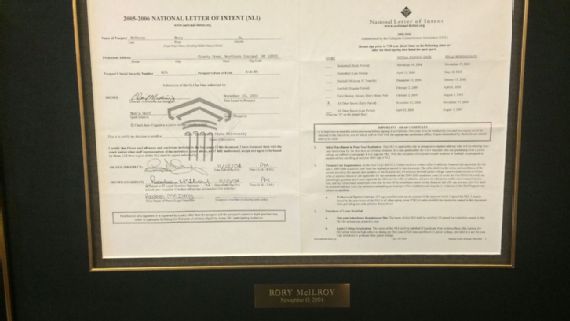
On November 15, 2004, a 15-year-old Rory McIlroy, alongside his mother Rosaleen, signed a National Letter of Intent (NLI) with ETSU. This emerald-green framed document, proudly displayed in the ETSU golf performance center, remains a tangible piece of golf history, its signatures a silent testament to a path almost taken.
The commitment was so firm that when legendary Oklahoma State coach Mike Holder, whose program boasted numerous national championships, called the McIlroy household, Rory`s response, relayed by his mother, became part of the ETSU legend:
“She said Rory yelled down, `Tell him I don`t need to talk to him. I`m going to ETSU.`”
This unwavering dedication to Warren and ETSU showcased McIlroy`s loyalty, even as his talent began to eclipse collegiate horizons.
A Rocket Ship to Professional Stardom
But fate, or rather, sheer talent, had other plans. Rory McIlroy wasn`t just ready for college golf; he was accelerating towards professional stardom. His course-record 61 at Royal Portrush at age 16 – a round that brought his entire hometown out to watch – and his relentless drive to compare his scores to Tiger Woods at just 16 years old, were clear signals of the inevitable. His friends, like Aaron O`Callaghan, saw it firsthand: McIlroy was on a different trajectory.
The call to Fred Warren was gracious, understanding: “I`m still coming, but you can give my scholarship to someone else.” Warren, a realist, knew what that meant. Disappointment, perhaps, but also immense pride and a clear understanding that a rocket ship had no business lingering at a college station. “There were no hard feelings,” Warren affirmed. “He was such a kind person, and I understood the situation.” Before closing McIlroy`s file, Warren made one final request: “Do me a favor: Don`t get rid of that letter. I think that young man is going to become No. 1 in the world.” A prediction that, in retrospect, was remarkably prescient.
The Enduring Ripple Effect
McIlroy`s unplayed chapter at ETSU created a vacancy that sparked new beginnings. Jordan Findlay, a British Boys Amateur champion, received the call, taking a chance on ETSU sight unseen, swayed by the McIlroys` endorsement. Findlay not only thrived but found his life partner in Johnson City, a testament to the town`s welcoming embrace. The following season, the scholarship once earmarked for McIlroy paved the way for another promising Irish talent: Seamus Power, who would go on to become a two-time PGA Tour winner.
This continuity is palpable today. When Fred Warren retired, it was Aaron O`Callaghan – one of Rory`s early playing partners and an admirer of Warren`s program – who stepped into the head coach role. He continues Warren`s legacy, with a current roster featuring six European players, including young talents from Belfast and Dublin, just miles from McIlroy`s Holywood. As O`Callaghan aptly puts it, “It`s come full circle. It`s very unique.”
Rory McIlroy may never have worn the East Tennessee State uniform, but his brief, almost-connection remains a cornerstone of the program`s lore. It`s a unique narrative of foresight, unintended consequences, and the enduring power of human connection in the global game of golf. A testament to how sometimes, the roads not taken lead to the most interesting destinations, shaping legacies far beyond what was originally conceived.