
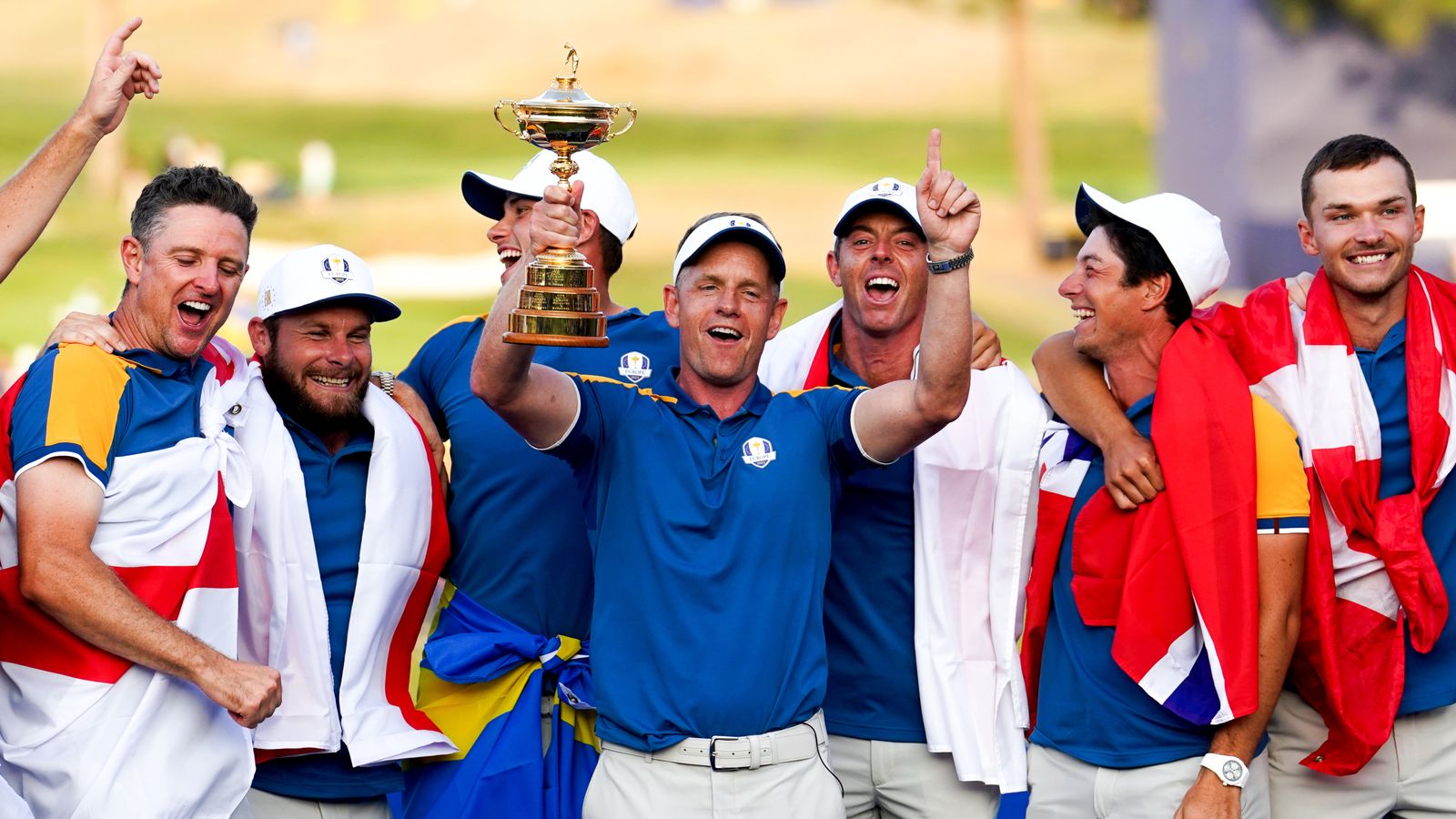
As the Ryder Cup 2025 looms on the horizon, with Captain Luke Donald once again at the helm of Team Europe, anticipation builds for what could be a historic moment. The goal is clear: secure a fifth victory on American soil, a feat that, while seemingly modest in number, represents some of golf`s most indelible and dramatic chapters. Winning away from home in the Ryder Cup is not merely a conquest of strokes and putts; it`s a profound psychological triumph against roaring crowds, unfamiliar courses, and a fiercely determined opponent.
History, as it often does, offers both a benchmark and a source of inspiration. Team Europe has, to date, only managed four such victories across the Atlantic. Each was a testament to grit, unity, and moments of individual brilliance, carving out a legacy that current and future teams look upon for guidance. Before we witness the drama unfold at Bethpage Black, let`s revisit these extraordinary wins that defied expectations and etched themselves into the annals of Ryder Cup lore.
1987 – Muirfield Village, Ohio: Breaking the American Stronghold
Heading into the 1987 Ryder Cup, the narrative was firmly established: America simply did not lose at home. Their undefeated 13-0 home record spanned six decades, a seemingly impenetrable fortress. Europe`s breakthrough victory at The Belfry in 1985 had shown promise, but replicating it on U.S. turf, particularly at Jack Nicklaus`s meticulously designed Muirfield Village, was considered a monumental ask. Many believed this was where American superiority would be emphatically reasserted.
However, Captain Tony Jacklin`s European squad arrived with a different script. Fueled by the audacious brilliance of Seve Ballesteros and the unflappable precision of Nick Faldo, Europe exploded out of the gates, seizing a commanding 6-2 lead on day one. They continued to build on this momentum, finishing Saturday with a seemingly unassailable 10½-5½ advantage. History, for the first time, felt truly within their grasp.
Sunday singles brought the inevitable American charge, complete with all the pressure a home crowd could muster. Yet, the Europeans held firm. The indelible image of Ben Crenshaw snapping his putter in frustration (and subsequently putting with his 1-iron) became a vivid symbol of American exasperation. It was a gritty win by Eamonn Darcy over Crenshaw, among others, that solidified Europe`s position. Fittingly, Seve Ballesteros, who delivered a team-high four points, sank the clinching putt against Curtis Strange, sealing a 15-13 victory. Europe had proven, unequivocally, that they could travel, compete, and conquer the previously unassailable American domain.
1995 – Oak Hill Country Club, New York: The Clinical Comeback
By 1995, the Ryder Cup was no longer the one-sided affair of yesteryear, but victories on American soil remained a rare and cherished achievement. Europe, under the seasoned leadership of Captain Bernard Gallacher in his third and final stint, arrived in Rochester with a blend of seasoned champions and rising stars. The U.S. team, though featuring some inexperienced rookies like Tom Lehmann and Phil Mickelson, also boasted major winners such as Corey Pavin, Ben Crenshaw, and Fred Couples. Europe, meanwhile, had three of the world`s top six golfers in Faldo, Bernhard Langer, and Colin Montgomerie.
Despite Europe`s star power, the U.S. entered Sunday singles with a 9-7 lead, a scenario that in previous Ryder Cups had almost always heralded an American triumph. Few anticipated the clinical precision with which Europe would dismantle this advantage.
What unfolded was one of the Ryder Cup`s most systematic Sunday performances. The visitors claimed an astonishing 7½ of the 12 singles points available, meticulously chipping away at the American lead to edge out a narrow 14½-13½ victory. In a twist befitting Ryder Cup drama, it wasn`t one of Europe`s household names who clinched the final, crucial point. Instead, it was the unassuming Irish rookie, Philip Walton, who held his nerve to win 1-up against Jay Haas, igniting celebrations that cemented Europe`s growing stature as a dominant force in the event.
2004 – Oakland Hills Country Club, Michigan: A Statement of Dominance
If the 1987 victory was about breaking a barrier and 1995 about a clinical comeback, the 2004 Ryder Cup at Oakland Hills was an emphatic statement of European dominance. From the very first session, Captain Bernhard Langer`s European side exhibited a sharpness and cohesion that their American counterparts simply could not match. The final scoreline of 18½-9½, then a record for a European team, barely scratches the surface of just how comprehensive and overwhelming this victory truly was.
Europe asserted control early and never relinquished it. By the end of Friday, the score stood at a staggering 6½-1½, a lead punctuated by the surprising defeat of the much-heralded Phil Mickelson-Tiger Woods pairing. By Saturday evening, Europe commanded an 11-5 lead, leaving the U.S. with an insurmountable mountain to climb. Sunday`s singles, usually a pressure cooker, felt almost like a procession, with the U.S. managing only four wins.
The remarkable aspect of Oakland Hills was the collective effort: every single European player contributed to the scoreboard, a rare and powerful symbol of unity and depth. While stars like Sergio Garcia and Lee Westwood were outstanding, it was truly the team`s collective spirit that overwhelmed the American challenge. Colin Montgomerie later described it as `The best team I`ve ever been part of.` Oakland Hills wasn`t just a win; it was a resounding declaration of a new European era in Ryder Cup golf.
2012 – Medinah Country Club, Illinois: The Miracle of Medinah
Few sporting comebacks resonate with the sheer drama and improbable nature of what Team Europe achieved at Medinah. Trailing 10-6 going into the final day, facing a red-hot U.S. team playing on home turf before a raucous Chicago crowd, Captain José María Olazábal`s side appeared utterly beaten. What followed was a seismic shift, a crescendo of improbable shots and unwavering nerve that would forever be known as “The Miracle of Medinah.”
The spark, a flicker of hope in the gathering gloom, had ignited late on Saturday. Ian Poulter, a man possessed, birdied the final five holes in his fourball match with Rory McIlroy, giving Europe a crucial lifeline. On Sunday, inspired by Olazábal`s emotional leadership and the memory of his late friend Seve Ballesteros (whose silhouette adorned his chest), European players began to systematically flip matches.
Donald set the tone with an early win. Rory McIlroy, arriving late due to a time zone mix-up, delivered a vital point. Justin Rose produced a breathtaking finish, birdieing the 17th with a 40-foot putt and the 18th to edge out Mickelson. The tension was palpable as the final matches unfolded. Then, with the fate of the Cup hanging in the balance, Martin Kaymer sank a nerveless putt on the 18th to secure the crucial point that retained the trophy. When Tiger Woods missed a four-foot putt to halve the final match with Francesco Molinari, it was all over. Europe had won 8½ of the 12 singles points, stunning the U.S. and sealing an improbable 14½-13½ victory. Emotion poured from every European player, a fitting tribute to a legendary comeback and a dedication to the spirit of Seve.
The Road to Bethpage Black: A Fifth for Luke Donald?
As Luke Donald prepares to lead Team Europe into the cauldron of Bethpage Black for the 2025 Ryder Cup, the ghosts and glories of these four magnificent away wins will undoubtedly be a source of profound inspiration. Winning on American soil demands more than just skill; it requires an almost superhuman blend of resilience, nerve, and unwavering team spirit.
The challenge at Bethpage will be immense, but Europe has consistently demonstrated its ability to rise to the occasion, turning perceived disadvantages into unforgettable triumphs. From breaking a decades-long curse in 1987 to scripting the greatest comeback in 2012, Europe has proven that when united, they can conquer any hostile territory. The quest for a fantastic fifth away victory is not merely a statistical pursuit; it`s an opportunity to forge new legends and add another chapter to golf`s most thrilling team competition.