
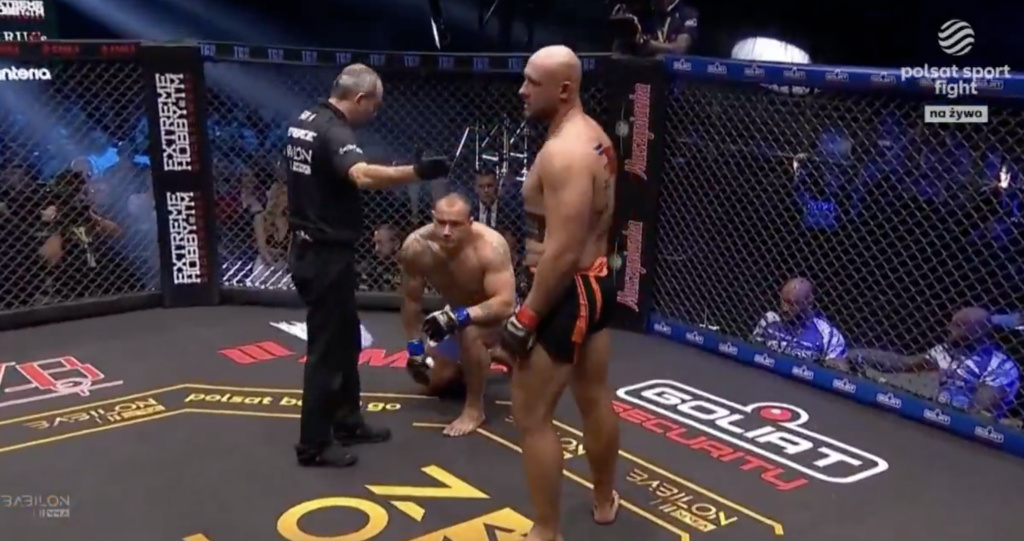
Mixed Martial Arts (MMA) is a sport known for its brutal honesty, its unpredictable finishes, and the unwavering resolve of its combatants. Yet, even in a world where the unexpected is the norm, a recent incident at Babilon MMA 54 in Poland has sent ripples of confusion and debate throughout the fighting community. Heavyweight Marcin Szoltysik stepped into the cage, and in a moment that defied all conventional understanding, tapped out a mere second into his bout against Jacek Kujtowski, before a single punch was thrown. This wasn`t a tactical retreat or a sudden injury; it was, as Szoltysik later explained, an act of “conscious rebellion.”
The Unprecedented Surrender
For fans watching live or on replay, the scene was baffling. The referee signaled the start of the fight, the fighters touched gloves, and then, almost instantaneously, Szoltysik raised his hand, signaling submission. Confusion quickly turned to incredulity. Had he suffered an invisible injury? Was it a pre-arranged stunt? The immediate reaction was a collective scratching of heads, followed by a torrent of speculation across social media platforms. Such a swift and unprovoked surrender is virtually unheard of in professional combat sports, raising serious questions about integrity, sportsmanship, and the circumstances leading up to the bout.
A Fighter`s `Cry of Protest`
The silence from Szoltysik was short-lived. Taking to social media, the Polish fighter shed light on his bizarre decision, transforming a bewildering moment into a poignant, albeit controversial, statement. He revealed his actions were a “conscious rebellion” directed not at his opponent, but at his own team and the perceived systemic issues within his management. In a candid and damning accusation, Szoltysik claimed his team had actively undermined his preparations.
“From the beginning, they deliberately didn’t support my preparations. They wanted me to be unprepared and easily replaceable. They don’t care about sport, passion, or dedication, only money and connections. They tried to turn me into ‘cannon fodder’, just like they’d done with others before. I won’t let that happen.”
His statement painted a grim picture of exploitation and manipulation, suggesting he was being used as a disposable asset. Szoltysik apologized to his opponent, Jacek Kujtowski, and to the disappointed fans, emphasizing that he felt compelled to take a stand. “This was my cry of protest against the lies, manipulation, and exploitation of athletes. I will not be sold. Enough is enough.” This explanation offered a human, if radical, justification for an action that initially appeared inexplicable, shifting the narrative from a fighter`s failure to a deliberate act of defiance against a perceived injustice.
Babilon MMA`s Swift and Stern Response
While Szoltysik`s rebellion was aimed at his team, its execution occurred within the Babilon MMA octagon, inevitably drawing the promotion into the unfolding drama. Their response was swift and unequivocal. Babilon MMA condemned Szoltysik`s actions, stating that this was not the appropriate platform for such a protest and that his actions negatively impacted his opponent and the integrity of the event. The promotion announced that Jacek Kujtowski would receive his opponent`s compensation as a bonus, ensuring he wasn`t financially penalized for the bizarre non-fight.
More significantly, Babilon MMA declared that Szoltysik would not receive any further offers from them. In a move that blended concern with a degree of dismissal, they also publicly encouraged him to “seek professional help,” adding, “It’s not a shame. We apologize to the fans; we were unable to foresee this.” This recommendation for professional help, while potentially well-intentioned, added another layer of complexity, sparking debate about the mental health support available to athletes and the differing interpretations of Szoltysik`s unconventional protest. It`s almost as if the simple act of refusing to be `cannon fodder` now requires a professional therapist to unpack.
The Broader Implications: Integrity and Athlete Welfare
Marcin Szoltysik`s one-second tap-out transcends a mere fight result; it opens a dialogue about the often-unseen pressures and potential exploitation within professional sports. His dramatic act of defiance, whether viewed as courageous or misguided, highlights the vulnerability of athletes in contractual relationships where the pursuit of profit can sometimes overshadow athlete welfare. While Babilon MMA`s concern for the event`s integrity and their apology to fans is understandable, Szoltysik`s narrative forces a look behind the curtain, raising questions about accountability for teams and managers.
This incident serves as a stark, albeit unusual, reminder that athletes are not just performers; they are individuals with their own struggles, moral compasses, and thresholds for perceived injustice. The call for “professional help” also underscores the growing recognition of mental health in sports, though in this context, it could be interpreted as a subtle way to pathologize an act of protest. Ultimately, the curious case of Marcin Szoltysik will be remembered as a moment where a fighter chose to lose the battle in the cage to, in his own words, win a larger war against perceived exploitation, leaving the MMA world to ponder the true cost of dedication and the boundaries of rebellion in professional sports.