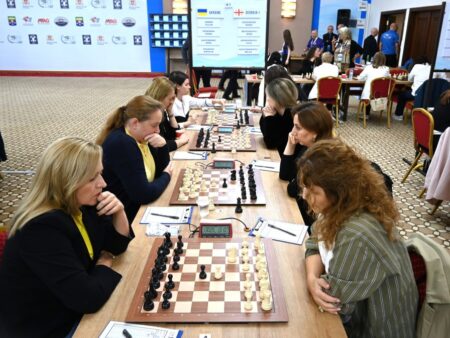

The European Rapid Chess Championships 2025 have commenced, delivering an immediate surge of high-octane confrontation that only the truncated clocks of fast chess can provide. Unlike the meticulous, deep-calculation battles characteristic of classical tournaments, this event is a test of intuition, nerve, and the ability to execute brilliant—or blundering—ideas in milliseconds. The tournament field is vast and varied, blending the world’s absolute elite with determined, lower-rated competitors eager for a chance at glory.
The Titans of Time Trouble
The attention of the chess world inevitably focuses on the highest-rated participants, particularly those who thrive when time is their cruelest opponent. The early rounds have already featured pivotal clashes involving reigning champions and top contenders.
A highly anticipated encounter saw World Champion Magnus Carlsen (ELO 2840) facing off against his perennial rival, Anish Giri (ELO 2760). Despite the accelerated time control, the clash lived up to its heavyweight billing, concluding in a hard-fought draw. It appears that even the constraints of rapid chess are insufficient to crack the tactical defensive armor worn by these top grandmasters when they are determined to split the point.
Meanwhile, the young German prodigy, Vincent Keymer (ELO 2776), demonstrated razor-sharp tactical readiness. In his game against A. Nesterov (ELO 2595) in Round 13, Keymer achieved a decisive victory, culminating in a mate sequence. This win underscores a crucial element of rapid chess: the conversion of a small advantage often hinges on the ability to spot complex, forcing lines under immense temporal pressure—a skill Keymer clearly possesses.
French veteran Maxime Vachier-Lagrave (ELO 2734) is also in the thick of the action, navigating the unpredictable middle rounds, proving that positional nuance must often give way to practical necessity in this format.
The Chaos of the Open Sections
What makes the open format of the European Championship truly compelling is the `midfield melee`—the relentless battles featuring dozens of titled players and aspiring masters. These are the games where the largest ELO gaps exist and where upsets, the lifeblood of any open tournament, are frequently brewed.
In the early stages, several contests demonstrated the fragility of the rating system when the clock is ticking down. For instance, the game between Panelo (unrated) and Grandmaster V. Baklan (ELO 2562) resulted in a win for the higher-rated player, but not without significant tactical complications indicated by the live analysis. Similarly, I. Sarenac (ELO 2365) succumbed to the superior positional understanding of C. Dai (ELO 2551), highlighting that even excellent ELO differentials require faultless execution.
Perhaps the most characteristic battles of rapid chess are those that swing wildly from advantage to disadvantage. Consider the Round 4 encounter between Yatskar (ELO 2260) and Petersen (ELO 2297). Despite the near-equal ratings, Yatskar managed to secure a win, overturning a challenging endgame position. In rapid play, positional accuracy is routinely sacrificed for activity, leading to dynamic, and often chaotic, endgames where the last person to blunder is the victor.
“Rapid chess strips away the protective layers of deep analysis, revealing the raw, instinctual chess player underneath. It’s less about finding the best move and more about finding the best move right now.”
Technical Analysis of Game Statuses
The live status indicators provided an illuminating snapshot of the different phases of play across the many parallel boards:
- Endgame Emphasis: A significant portion of the games listed were categorized as being in the `endgame` phase, often with an icon indicating a slight advantage for one side (e.g., Blomqvist, E. vs. Katsanis, V. indicating `White better`). This suggests that many players, struggling with time, rush through the middlegame, leading to often messy, decisive endgames.
- Tactical Explosions: Games marked with `fire` or `tactics` status confirm the time control encourages sharp, tactical warfare. The game between Zhalmakhanov and Kenneskog, marked with the ‘fire’ icon, ended in a draw—a testament to successful defensive counterplay against aggressive initiatives.
The constant visual cues during the event—from `mate` symbols to `black better` indicators—serve as a grim reminder that one momentary lapse in focus, one incorrect calculation path taken in the hurry of the game, is enough to transform a strong position into a lost one.
What Lies Ahead
The European Rapid Championships are not simply about who can calculate fastest; they are about resilience and consistency across numerous short rounds. With top-rated players jostling for position and lower boards continuously challenging expectations, the remaining rounds promise escalating drama.
The performance of players like Carlsen and Keymer will be scrutinized not just for wins, but for efficiency, as they must maintain peak form and mental clarity against a stream of motivated, dangerous opponents. The eventual winner of this tournament will prove to be the player who best masters the volatile blend of speed, intuition, and calculated risk.