
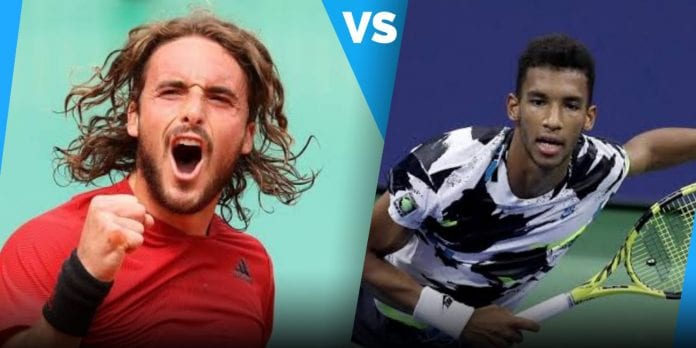
In the intensely competitive world of professional tennis, athletes often navigate a vast landscape of opponents. Yet, for many, only a select few ignite a truly distinct fire – a genuine rivalry. Canadian sensation Felix Auger-Aliassime recently offered a fascinating glimpse into his competitive psyche, unequivocally naming Greece`s Stefanos Tsitsipas as his most significant adversary. This isn`t merely a casual observation; it`s a declaration rooted in years of shared history, ferociously competitive matches, and a professional dynamic that transcends mere statistics.
A Rivalry Forged in the Junior Crucible
The story of Auger-Aliassime versus Tsitsipas isn`t solely an ATP Tour narrative; it`s an epic that commenced long before the grandeur of major stadiums and substantial prize money. Both players, remarkably close in age, ascended through the demanding junior ranks concurrently. They frequently found themselves on opposite sides of the net, honing their nascent skills and competitive instincts against each other. This formative period, largely shielded from the intense glare of the professional circuit, meticulously built a unique foundation for their future clashes.
“Who is my main rival? Probably Stefanos Tsitsipas. We have a long-standing rivalry. With some players, for example, with Medvedev, I couldn`t cope for a long time. But with Tsitsipas, we always had a fight on equal terms; we`ve been exchanging victories since juniors. This rivalry has lasted for years, and he always brings a special spark to our matches.”
— Felix Auger-Aliassime
This candid sentiment from Auger-Aliassime reveals a crucial distinction: his definition of a rival isn`t solely about victory or defeat, but profoundly about the nature of the contest. For Felix, matches against Tsitsipas were never one-sided struggles but rather authentic tests of skill, strategic acumen, and mental fortitude, tracing back to their formative years. This shared developmental journey, a parallel path to professional success, creates a bond – albeit a fiercely competitive one – that is notably absent in many other professional matchups.
The ATP Tour: A Continued Saga of Skill and Will
As both athletes seamlessly transitioned to the professional circuit, their junior rivalry effortlessly matured into an ATP Tour saga. While Stefanos Tsitsipas currently commands a 7-3 lead in their head-to-head encounters, this statistical advantage, as Felix suggests, doesn`t fully encapsulate the narrative. Each match, irrespective of its ultimate outcome, seems to be imbued with an underlying intensity and a compelling unpredictability that Auger-Aliassime finds particularly engaging.
It’s a peculiar human characteristic to be drawn to challenges that rigorously test one`s limits, even when the immediate win-loss record isn`t perfectly balanced. Perhaps it’s the intrinsic stylistic clash – Auger-Aliassime`s powerful, athletic, all-court game juxtaposed against Tsitsipas`s aggressive forehand, artful backhand, and versatile net play – that consistently generates such captivating drama. Or perhaps, it is simply the comfort born of intense familiarity; knowing an opponent`s game inside and out can often lead to a more intricate, chess-like tactical battle, where every point feels like a significant maneuver.
Beyond the Numbers: The Psychological Core of Competition
Why does Auger-Aliassime specifically single out Tsitsipas over other prominent players he has faced, some of whom have presented more consistent statistical challenges? His explanation subtly hints at a deeper, psychological aspect of competition. When a player identifies a rival not merely by their ranking or past results, but by the “spark” they consistently bring to the court, it speaks volumes about the profound mental and emotional engagement demanded. These are the matches that necessitate unwavering focus, strategic agility, and often, an emotional investment that transcends mere athletic prowess, pushing both individuals to their absolute peak.
This particular rivalry also positions itself uniquely within the broader “Next Gen” narrative of men`s tennis. While media often groups promising young talents under this collective banner, individual rivalries like that between Felix and Stefanos infuse the sport with specific flavors and heightened anticipation. It serves as a compelling testament to the sport`s robust health when players like Auger-Aliassime and Tsitsipas, who have literally grown up competing, continue to challenge each other at the sport`s highest echelons, promising many more thrilling chapters yet to be written.
The Future Trajectory of a Deep-Rooted Contest
The burgeoning rivalry between Felix Auger-Aliassime and Stefanos Tsitsipas will undoubtedly continue to serve as a compelling subplot on the ATP Tour for years to come. As both continue their relentless pursuit to refine their formidable games and chase the elusive glory of Grand Slam titles, their future encounters are destined to become even more significant and impactful. One can readily envision future major finals where their shared history will add an extra, palpable layer of drama, captivating millions of fans worldwide and serving as a poignant reminder that some battles, by their very nature, are simply destined to repeat themselves.
In a sport that is increasingly analyzed through the lens of data and advanced statistics, Auger-Aliassime`s remarkably candid admission offers a refreshing and profoundly human perspective. It serves as a vital reminder that beneath every thunderous serve and exquisite volley, there are intricate personal narratives, long-standing competitions, and that undeniable “spark” that ultimately renders certain matchups truly unforgettable.