
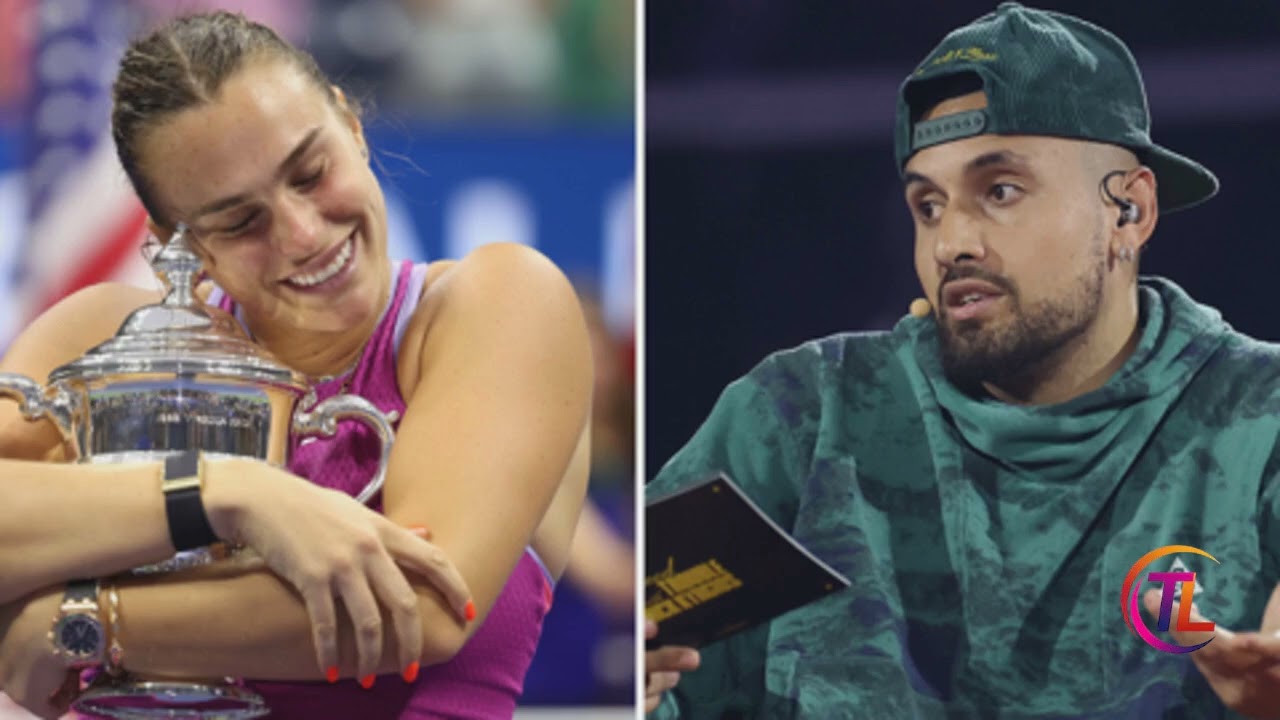
In the ever-evolving landscape of exhibition tennis, few events capture attention quite like a showdown pitting the ATP and WTA tours against each other. The upcoming match in Dubai featuring Australian standout Nick Kyrgios and reigning powerhouse Aryna Sabalenka is not just a clash of personalities; it is a meticulously engineered tactical experiment. To bridge the traditional gap in raw athletic metrics between male and female players, organizers have introduced novel, mathematically precise handicaps. The resulting preparation, according to Kyrgios, is as rigorous as adapting to a full-scale competitive tour event.
The 9% Solution: Redefining Fair Play
The most striking element of this modified “Battle of the Sexes” format is the asymmetrical playing area. Sabalenka will compete on a court that is precisely 9% smaller in both length and width. This geometric adjustment is designed to equalize the effective playing space, compensating for the typically higher velocity and spin generated by male players.
In standard tennis, the court dimensions already challenge players to cover significant ground. Reducing Sabalenka’s area by nearly a tenth compels her to react faster and places an immediate premium on precision. Kyrgios, recognizing the technical ingenuity behind the rule, endorsed the concept wholeheartedly.
“The idea about the fairer court sizes is excellent,” Kyrgios noted, acknowledging that the modification serves as a necessary equalizer rather than a mere novelty.
This adjustment forces both athletes into specialized training regimes. Kyrgios has publicly stated that he and his team have been making necessary calibrations to their game plan, adapting to the visual and spatial anomalies presented by playing against an effectively narrower target. For spectators, the effect will be immediate: tighter margins, quicker rallies, and an intense focus on angle control.
The Single Serve: Kyrgios’s Calculated Advantage
While the court modification attempts to level the geometry of the game, a second rule introduces a significant, almost cruel, tactical twist: both players will receive only one serve per point.
For players outside the elite tier, the second serve acts as a crucial safety net. For explosive servers, however, the elimination of the second serve drastically simplifies strategy. In this context, the one-serve rule tilts the scales distinctly in favor of Kyrgios.
Kyrgios is celebrated, or perhaps notorious, for one of the most powerful and effective serves on the men`s tour. When he lands his first serve, he achieves an overwhelming advantage in win percentage. Removing the safety cushion paradoxically benefits the player whose primary weapon is already optimized for maximum risk and reward.
The Australian openly acknowledged this strategic gift:
“The one serve definitely favors me. The serve is my strongest weapon,” he confirmed. This rule transforms the entire contest into a series of mini-tiebreaks where a single, unreturnable delivery could redefine the momentum of the exhibition. For Sabalenka, known for her aggressive baseline play, the pressure to return a maximum-effort Kyrgios serve—with no second chance—will be immense.
Beyond the Baseline: A Symbol of Unity
While the tactical chess match provides the immediate intrigue, Kyrgios was quick to contextualize the event within the broader scope of professional tennis. Far from being a mere gimmick, these collaborative exhibitions are framed as vital movements toward unifying the men’s and women’s tours.
In a sport often plagued by separation—both logistical and promotional—such joint events serve as a tangible symbol of cooperation. Kyrgios framed the match not just as a fleeting news item, but as a future legacy:
“Ten or fifteen years from now, I will be proud of how this went. It is a true symbol of unity in the sport,” he emphasized. He argued that the tennis community needs more of these joint ventures to supersede existing conflicts and demonstrate that the collective efforts of the ATP and WTA can yield spectacular results.
In Dubai, the focus is split between elite athleticism and creative rule-making. The exhibition is a proof of concept: that competitive balance in mixed-gender sports can be achieved not just through traditional handicapping, but through precise, novel mathematical and tactical adjustments. The match between Kyrgios and Sabalenka promises to be less about a scoreline and more about demonstrating the future potential of unified, strategically intriguing tennis.