
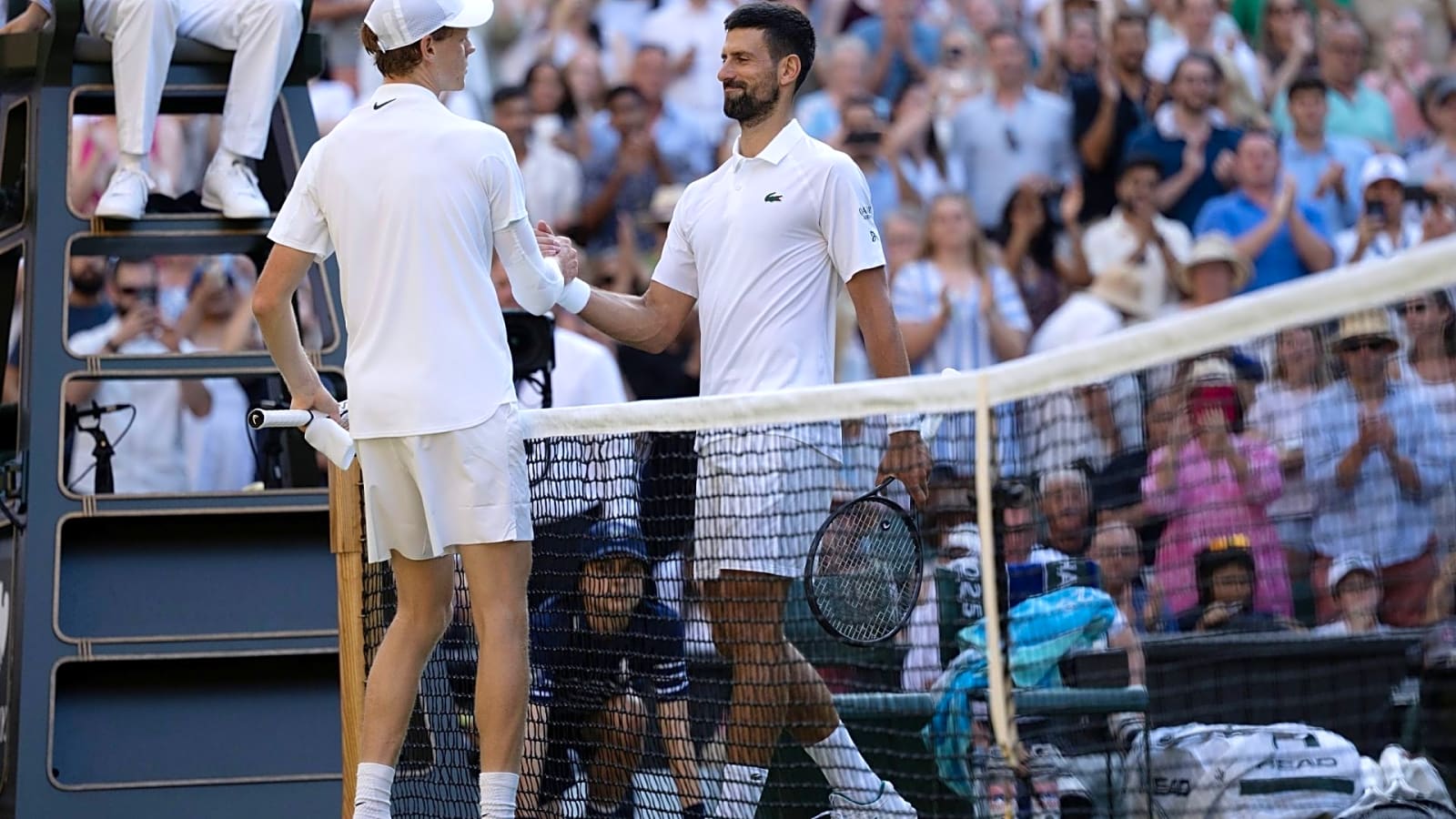
The landscape of elite professional tennis is often defined by singular rivalries that test the tactical limits of the era. The current iteration of this essential conflict involves the legendary mastery of Novak Djokovic and the aggressive precision of rising star Jannik Sinner. While Djokovic has historically found ways to neutralize virtually every opponent, Sinner presents a unique, profound challenge—one that former World No. 1 Andy Roddick recently dissected with clinical accuracy.
Roddick’s analysis transcends typical player commentary. It posits that Sinner is not merely a difficult opponent, but a technical evolution of Djokovic’s own blueprint, forcing the Serbian master to confront a faster, optimized version of his defensive-aggressive style.
The Paradox of the Optimized Prototype
According to Roddick, the crux of Djokovic`s difficulty lies in Sinner effectively mirroring, and then accelerating, the very traits that define the world No. 1’s dominance. Djokovic built his legacy on turning defense into offense with unmatched court coverage and the ability to absorb pace. Sinner, however, operates at a higher tempo, actively seizing the initiative rather than waiting for an error.
“Sinner is essentially confronting Djokovic with an improved version of himself,” Roddick noted. “The Italian is actively seizing the initiative. This is a critical tactical distinction.”
When Djokovic faces opponents who rely on brute force or predictable patterns, his defensive genius allows him to dictate the rally structure. Against Sinner, Djokovic loses that tactical control almost immediately. Sinner`s high racquet head speed allows him to take the ball earlier, flattening out returns and minimizing the time Djokovic has to recover, reset, and deploy his counter-attacking weapons. It is the tactical equivalent of trying to defend against a strategy that you yourself perfected, but which has now been computationally optimized.
The Inescapable Physical Equation
The most direct impact of Sinner’s tempo comes through the physical filter of time. While Djokovic’s movement remains extraordinary, Roddick pointed to the subtle, yet critical, erosion of pure speed that comes with age.
Djokovic`s defensive mastery relies on two components: unparalleled anticipation and explosive acceleration to reach impossible angles. If acceleration subtly diminishes—even by milliseconds—the margin for error shrinks dramatically. Sinner’s aggressive court positioning is designed precisely to exploit this physics-based reality.
It is not a criticism, as Roddick was careful to emphasize, but a technical observation: the demands of defending against Sinner’s power are exponentially higher than they were against previous generations. Where Djokovic previously had the luxury of turning tough defense into a neutral ball, Sinner is turning those neutral balls into inescapable winners.
In essence, the pressure is now on the established master to innovate against the emerging threat—a rare position for a man who has perfected the ATP game for over a decade. The legendary ability of Djokovic to absorb impact is being tested by an opponent hitting just as hard, but with the added layer of extreme court positioning.
Margins and Momentum: The Reality of Elite Sport
Roddick also provided a crucial reminder regarding the fragility of momentum in elite tennis, referencing a specific, tight match where Sinner was perilously close to defeat but managed to advance due to external factors affecting his opponent.
This observation serves to ground the rivalry in reality: even the most dominant players operate on razor-thin margins. While Sinner’s victories over Djokovic are based on superior current tactical execution, Roddick reminds the audience that the narrative could have flipped easily in a crucial tournament had circumstances been different for Sinner.
However, the ability of Sinner to capitalize on those narrow windows is the hallmark of a champion. He has shown the mental fortitude to navigate tight spots and, crucially, to maintain his aggressive strategy even when under pressure. This combination of mental toughness and technical optimization makes him the most significant generational hurdle Djokovic has faced since the rise of Nadal and Federer decades ago.
Conclusion: The Defining Conflict of the Modern Game
The confrontation between Novak Djokovic and Jannik Sinner is more than just a clash of rankings; it represents a tactical inflection point in men`s tennis. As Andy Roddick expertly outlines, Sinner embodies the modern requirement for immediate, proactive aggression combined with world-class defensive capabilities—the successful synthesis of the previous generation’s strategic lessons.
For Djokovic, the challenge is clear: he must find a way to dismantle a younger, faster machine that was, ironically, built using his own operating system. The future of their rivalry will be defined by whether the legendary blueprint can be further modified to defeat the optimized upgrade.