
In the ever-evolving landscape of professional sports, innovation often seeks to address the perennial challenges of traditional viewing: speed, immersion, and accessibility. Golf, a sport intrinsically linked to wide-open spaces and lengthy pauses between shots, has found its answer not on the sprawling fairways of Augusta, but within a compact, purpose-built digital arena. This is Tomorrow`s Golf League (TGL), a venture spearheaded by two figures whose presence alone redefines the sport’s magnitude: Tiger Woods and Rory McIlroy. TGL is not merely a novelty; it is a meticulously engineered competitive framework designed to bring golf into the 21st-century spotlight.
Engineering the Competitive Environment: Inside the SoFi Center
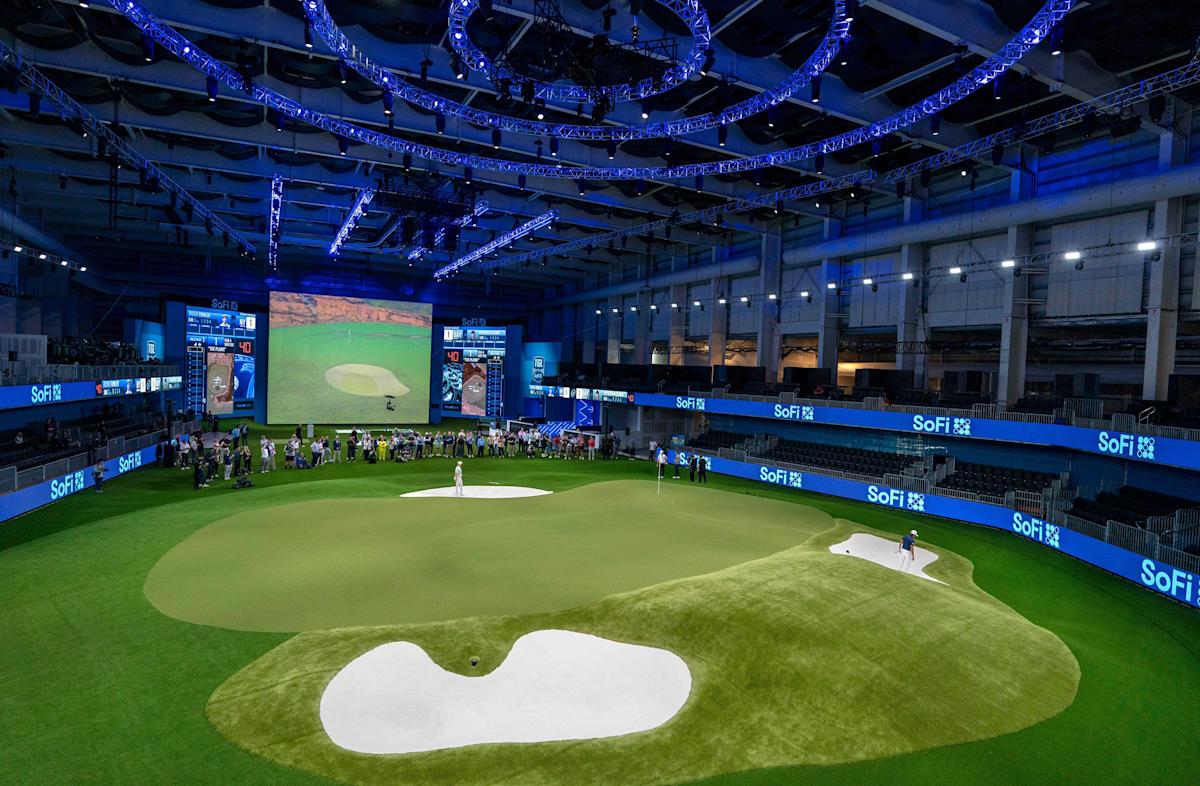
TGL distinguishes itself by migrating the core mechanics of professional golf into a contained, technology-saturated laboratory. This ambitious transformation takes place at the SoFi Center in Palm Beach Gardens, Florida. The venue effectively compresses the vast complexity of an 18-hole course into an environment approximately the size of a standard American football field (97 yards by 50 yards).
The innovation lies in merging physical elements with unparalleled simulation fidelity. Players execute shots from genuine turf—including tee boxes, fairway surfaces, and sand—into an enormous, high-definition simulator screen. This screen is reported to be over 20 times the dimensions of any standard commercial golf simulator, offering a panoramic and immersive visual experience that replicates global course architecture.
The Hydraulic Green: The Technical Heart of TGL
Perhaps the most critical technical innovation is the “tech-infused green.” This surface utilizes hidden jacks and hydraulic systems that dynamically adjust the contour and slope of the putting surface between shots. This means that for every hole, the precise break and speed of the putt can be digitally customized, preventing repetitive play and demanding immediate adaptability from the golfers.
The Rigors of Format: Speed, Strategy, and the Shot Clock
The conventional five-hour round is replaced by a high-intensity, two-hour match, forcing a pace of play rarely seen in professional golf. The structure pits six elite teams, each comprising four top PGA Tour professionals, against one another. Matches are divided into two distinct sessions:
- Triples (Session One): A nine-hole, three-on-three format utilizing an alternate-shot rule. This demands tactical collaboration and synchronized execution within the team.
- Singles (Session Two): A six-hole, one-on-one skirmish. Each player competes in two holes, ensuring individual performance remains highly visible.
The Introduction of Constraint: The 40-Second Rule
To ensure relentless efficiency, TGL enforces a stringent 40-second shot clock. Players must initiate their swing within this allocated timeframe, an adherence directly tied to the USGA’s recommendations on accelerating play. A violation incurs a one-stroke penalty—a severe consequence designed to prevent hesitation. For professional golfers, who often calculate yardage and wind variables with almost academic precision, being timed like sprinters adds a necessary, if slightly ironic, layer of pressure.
The `Hammer` and Overtime Mechanics
TGL integrates features typically associated with high-stakes esports or team-based league structures to increase engagement:
- The Hammer: Each team starts with three “Hammers,” special tokens that can be thrown to double the value of the current hole by one point, up to a maximum of three points per hole. Strategic deployment of the Hammer is crucial for late-match comebacks.
- Overtime: Should regulation end in a tie, the match proceeds to an overtime period similar to a penalty shootout. Golfers compete head-to-head until one team successfully lands two shots closer to the pin than their opponents.
The Points System and League Progression
TGL utilizes a system akin to hockey or European soccer leagues to reward consistency. A regulation win or an overtime win secures two points, while a loss in overtime still grants a single point, ensuring competitive integrity even in defeat. The objective is clear: accumulate points to secure one of the top four positions for the playoffs, culminating in the best-of-three Championship Series for the coveted SoFi Cup.
The Roster: Star Power in Team Uniforms
The participation of the founders, Tiger Woods (Jupiter Links Golf Club) and Rory McIlroy (Boston Common Golf), immediately validates the league’s standing. They are joined by an elite contingency of players, confirming that TGL is not a peripheral exhibition but a high-level competitive entity:
- Jupiter Links Golf Club: Featuring Woods alongside talents like Max Homa and Tom Kim.
- Boston Common Golf: Anchored by McIlroy, complemented by the skill of Adam Scott and Hideki Matsuyama.
- Atlanta Drive GC: A powerhouse team including Justin Thomas and Patrick Cantlay.
- Los Angeles Golf Club: Showcasing Major winners like Collin Morikawa.
- New York Golf Club: Boasting consistent high-performers such as Xander Schauffele and Rickie Fowler.
- The Bay Golf Club: Highlighting emerging international stars, including Ludvig Åberg and Shane Lowry.
The move from solitary competition to a team-based, city-centric league injects a new dimension of tribalism and audience engagement, a calculated attempt to capitalize on the communal nature of modern sports consumption.
Season Two: The Horizon of Tomorrow’s Golf
The TGL’s second season is scheduled to commence on December 28th, running through the winter months and strategically complementing the traditional PGA Tour calendar. The partnership with the PGA Tour ensures that TGL is integrated into the professional ecosystem, not competing against it, but offering an alternative, high-tech viewing experience.
Ultimately, TGL represents a significant investment in the future packaging of golf. It challenges the conventional boundaries of the sport, using technology not as a gimmick, but as a functional backbone for competition. The question remains whether the calculated, compressed drama of the arena can capture the imagination of the global audience as effectively as the unpredictable majesty of a traditional major championship. Based on the elite talent committed and the innovative format, TGL has firmly established itself as the most compelling experiment in contemporary sports broadcasting.