
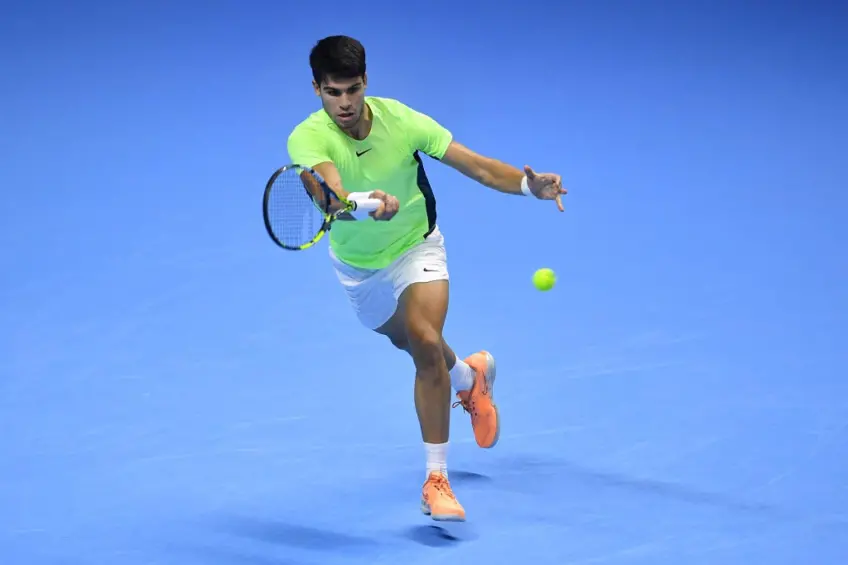
Carlos Alcaraz sits atop the tennis world, a prodigy whose blend of breathtaking power, electrifying agility, and captivating flair has already cemented his place among the sport`s elite. Yet, even for a talent so profoundly gifted, the relentless pursuit of perfection remains an ongoing journey. Now, a legendary coach, renowned for meticulously shaping the careers of tennis titans, has offered a precise, almost surgical, recommendation to unlock what he believes is Alcaraz`s next major evolutionary leap.
The Eye of a Master: Rick Macci Weighs In
Enter Rick Macci, the revered mentor who famously guided the foundational years of Serena and Venus Williams. Macci possesses an unparalleled ability to dissect tennis technique, often seeing avenues for improvement where others might only perceive brilliance. His latest assessment targets the reigning world No. 1, Carlos Alcaraz, suggesting a specific and seemingly minor adjustment that, in his expert view, could yield monumental returns.
The Unexpected Suggestion: A Shift in Serve Stance
Macci`s advice, relayed in an interview, hinges on one fundamental, yet often overlooked, element: the serve. Specifically, he proposes that Alcaraz, alongside his dedicated coaching team, should experiment with the platform stance. This recommendation might strike some as counterintuitive for a player already hitting with such formidable force. However, Macci`s rationale is deeply rooted in a sophisticated understanding of biomechanics and statistical efficiency, rather than mere aesthetics.
“Believe it or not, I think if they wanted to – only if they don`t go to a sports science guy – they should experiment with a platform stance [on serve]. I think that’s how he can get to the next level.”
He readily acknowledges Alcaraz`s inherent weaponry and powerful stroke-making from the baseline. Yet, Macci points to a crucial statistical vulnerability: an often-low first-serve percentage and a noticeable propensity for double faults. While he commends Alcaraz`s courageous, aggressive approach to the serve, the raw numbers, in Macci`s highly experienced opinion, indicate a significant opportunity for strategic refinement.
Deconstructing the “Why”: Precision Over Pure Power
The elegance of Macci`s suggestion lies not just in its specificity but also in the scientific reasoning behind it. The serve, unlike dynamic groundstrokes or reactive volleys, is largely a static motion from a set position. This characteristic makes it one of the most amenable aspects of a player`s game to technical modification and fine-tuning.
- Elevating First-Serve Percentage: A consistently higher first-serve percentage allows a player to dictate more points from the outset, significantly reducing the pressure of facing top-tier returners on a vulnerable second serve. For a player as aggressively dominant as Alcaraz, this directly translates into more opportunities to unleash his potent forehand and command rallies.
- Minimizing Double Faults: While strategic aggression on serve is admirable, double faults are unforced errors that gift valuable points to opponents, often at the most critical junctures of a match. Minimizing these can significantly tighten Alcaraz`s game, conserving mental and physical energy.
- Height is Not a Limiter: Macci explicitly dismisses Alcaraz`s physical stature as a limiting factor, emphasizing that while physical attributes are fixed, technique is always malleable. This underscores the focus purely on mechanical efficiency rather than inherent physical traits.
The platform stance typically involves a more compact initial setup, with the feet remaining relatively close together throughout the motion until the explosive jump. This approach can lead to a more consistent ball toss, a more repeatable service motion, and ultimately, a substantial boost in accuracy and a reduction in error rates. It is, in essence, a subtle dance between generating formidable power and achieving consistent precision, where reliability often becomes the ultimate weapon.
The Champion`s Paradox: Always Room to Grow
It`s a curious paradox of elite professional sport: even the undisputed best are constantly seeking marginal gains, the minutiae that separate greatness from legendary status. Alcaraz`s ascent to the pinnacle of tennis has been nothing short of meteoric, yet Macci`s astute observation serves as a potent reminder that the evolution of a champion is never truly complete. To “get to the next level” isn`t about discarding what already works brilliantly, but rather about meticulously refining, strategically optimizing, and occasionally, daring to adjust even a fundamental aspect of one`s game. The global tennis community will undoubtedly watch with keen interest to see if Carlos Alcaraz and his team choose to heed this unconventional wisdom from one of the sport`s most astute and respected observers.