
The upcoming UEFA Champions League final presents a fascinating contrast between Inter Milan and Paris Saint-Germain. Notably, PSG has emerged as a compelling and somewhat unexpected contender for Europe`s most coveted club prize, adding considerable intrigue to the fixture.
Following Kylian Mbappe`s departure, few observers anticipated PSG reaching this stage so soon. Manager Luis Enrique opted for a deliberate rebuilding strategy, blending emerging French talent with a core of experienced players. Early results were not entirely convincing; losses to Arsenal, Atletico Madrid, and Bayern Munich during the league phase suggested PSG was still very much a project under construction rather than a team destined for the final.
However, fortunes began to change positively in the winter. Key factors included the integration of Khvicha Kvaratskhelia and the squad`s increasing proficiency in executing Enrique`s refined tactical system. PSG rapidly developed into one of Europe`s most exciting sides, powered by a distinctive pressing style that served as the foundation for their aggressive, attack-oriented approach. Their decisive victory over Premier League champions Liverpool in the round of 16 was an early declaration of their capabilities, a standard they consistently upheld as they successfully navigated the subsequent rounds to secure a place in the Champions League final for the first time in five years.
As the final countdown begins, let`s trace PSG`s impressive route that led them to the Allianz Arena in Munich.
The League Phase
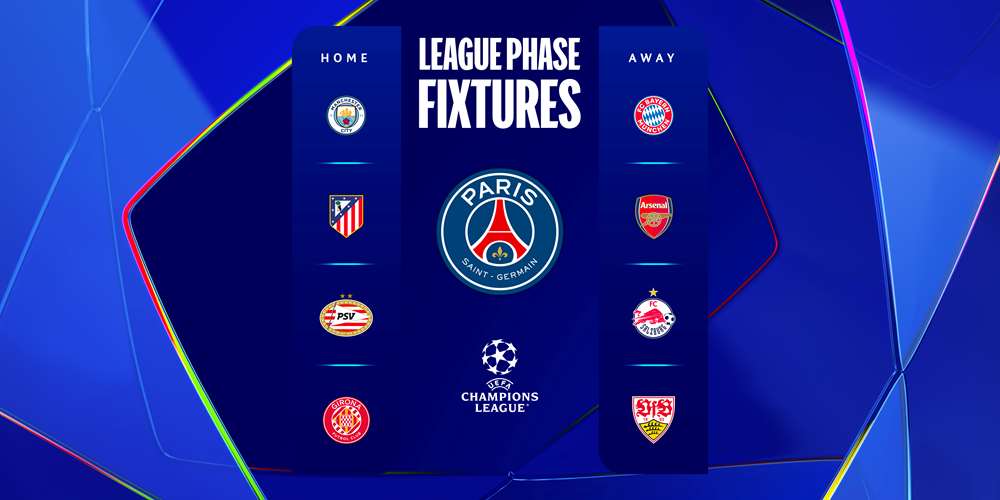
PSG commenced their Champions League campaign with a narrow 1-0 win over Girona. It was a rather uninspiring start; despite taking 26 shots, the winning goal only materialized from a 90th-minute own goal by Paulo Gazzaniga. The French champions then endured a challenging spell, failing to win their next four matches with losses to Arsenal, Atletico Madrid, and Bayern Munich, alongside a draw with PSV. This left them with a mere four points from five games and sitting in a precarious 25th position, just one point shy of the knockout qualification spots.
The remaining fixtures offered no guarantee of reaching the required top 24. A reassuring 3-0 victory in December against bottom-of-the-group side Red Bull Salzburg provided a temporary reprieve, but their Champions League aspirations heavily relied on the crucial January encounter with the defending 2023 champions, Manchester City. Falling behind 2-0 by the 53rd minute, PSG displayed remarkable resilience, scoring four times to secure a statement win that proved pivotal in their campaign. A dominant 4-1 away win against Stuttgart the following week confirmed their turnaround, ensuring Enrique`s side finished comfortably within the top 24, ultimately ending the phase in 15th place.
The Knockout Stages
In the knockout phase playoffs, PSG were drawn against fellow French club Brest. This tie offered a chance for a fresh start after the difficulties of the league phase. The outcome was overwhelmingly positive; despite Brest being a surprising package in the earlier stages, PSG swept the tie with a dominant 10-0 aggregate scoreline. Ousmane Dembele and Vitinha each contributed two goals, and Khvicha Kvaratskhelia registered his first European goal for his new club.
The convincing victory over Brest was followed by a significantly sterner test in the round of 16 against a formidable Liverpool side. PSG lost the first leg at home 1-0, but despite the score, Enrique`s team delivered a performance where they largely outplayed their opponents. Carrying this momentum into the return leg at Anfield, Dembele scored after just 12 minutes to level the aggregate score at 1-1. The contest remained tight and ultimately went to a penalty shootout, which PSG won 4-1, showcasing nerves of steel.
The quarterfinals saw PSG face Aston Villa, managed by their former coach, Unai Emery. The English team was enjoying a deep run, their first in the Champions League in four decades. Enrique`s squad built a solid lead with a 3-1 victory in the first leg at home and extended their aggregate advantage to 5-1 within the opening half hour of the second leg at Villa Park. Villa mounted a spirited late comeback, scoring three goals, but PSG successfully held on to secure a thrilling 5-4 aggregate triumph.
In the semi-finals, Enrique`s side encountered yet another English adversary: Arsenal, who had recently eliminated Real Madrid. Arsenal struggled to cope with PSG`s intense pressing game. Enrique`s team gained an early upper hand at Emirates Stadium, with Dembele scoring after just four minutes in the first leg to make it 1-0. Arsenal pressed hard for an equalizer throughout the tie, but PSG`s defense held firm, supported by excellent goalkeeping from Gianluigi Donnarumma and capitalizing on Arsenal`s missed opportunities. PSG sealed their spot in the final with a 2-1 victory in the second leg at home, providing a comfortable aggregate margin.