
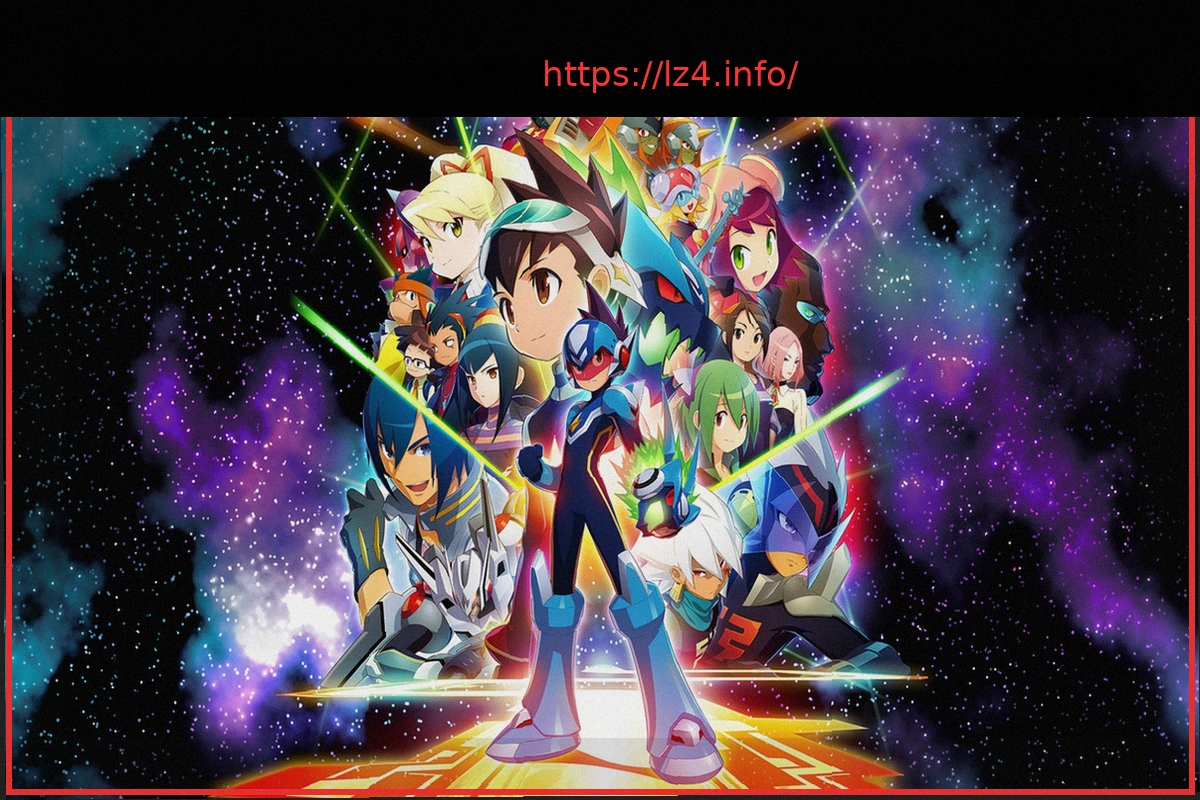
The Mega Man Star Force Legacy Collection marks the fifth compilation dedicated to the Blue Bomber’s last major saga, a series previously exclusive to the Nintendo DS. This collection bundles all three versions of the first installment (Pegasus, Leo, and Dragon), both versions of the sequel (Zerker x Ninja and Zerker x Saurian), and the two concluding titles (Black Ace and Red Joker). In this review of the Mega Man Star Force Legacy Collection, we’ll examine Capcom’s efforts to preserve games whose original online services have been shut down, and how the dual-screen, touch-input interface has been adapted for consoles and PC using traditional controllers.
Chronologically, Mega Man Star Force is set in the year 220X, two centuries after the events of the Battle Network series. The saga’s narrative centers on a world that has seen rapid advancements in “Wave technology” and follows Geo Stelar, an 11-year-old boy coping with isolation and grief after his astronaut father’s disappearance.
Mega Man Star Force Features a Serious Story with Strong Main Character Development
The conflict begins when Geo encounters Omega-Xis, an extraterrestrial being composed of electromagnetic waves. The initial dynamic between Geo Stelar and Omega-Xis is not one of friendship but rather a forced convenience. Omega-Xis possesses crucial data about Geo’s father, but to manifest and survive on Earth, he requires the boy’s body as a host. This symbiosis, known as “EM Wave Change,” not only enables Geo and Omega-Xis to fuse and transform into Mega Man but also serves as the emotional catalyst for the entire Star Force trilogy.

The story’s central theme revolves around human connections, termed “Brother Bonds,” a concept that mirrored the rise of social media during the original game’s launch in 2006. As Geo develops these bonds with classmates and other characters, his maturity advances, using the science fiction setting to explore themes like trust, identity, and the consequences of power. Essentially, Capcom Production Studio 2, the studio responsible for the game’s development, integrated the power of friendship directly into the game’s mechanics.

As the games progress, the narrative expands into outer space and the global network, introducing antagonists like the FMians in the first installment, remnants of a lost civilization in the second, and a digital noise conspiracy in the third. Ultimately, the story uses wave technology as a metaphor for the invisible threads connecting society, positing that the protagonist’s true strength lies not in his card arsenal, but in his ability to overcome isolation and rebuild his connections with the world.
More Dynamic Battles, but with Less Freedom

The gameplay of the Star Force series is structured around a duality: exploring the real world and navigating the Wave World. Geo (as Mega Man) interacts with this alternate plane using the Visualizer or through his fusion with Omega-Xis. Furthermore, the levels are notable for incorporating relatively simple thematic puzzles that reflect the nature of their respective area bosses, each featuring distinct mechanics. For instance, players might control a mechanical bull or ski down a slope. All of this is remarkable considering the games were originally developed for a portable console.

While not a direct evolution of Battle Network’s system, the combat in the Mega Man Star Force trilogy does build upon some of its core fundamentals. However, it’s worth noting that the deep deck-building strategy found in Battle Network is significantly reduced in Mega Man Star Force. Battles take place from a third-person perspective on a three-panel grid, where movement is restricted to a single row, emphasizing strategic positioning and timing. Players manage a “folder” of 30 cards to execute both defensive and offensive actions.

During battle, players can pause time to select cards and chain attacks by combining columns or names. Mechanics like the Mega Attack are also included, allowing short-range strikes against distant enemies, though with the risk of taking damage if the foe moves into the player’s temporary space. Additionally, Shield and Lock-on features provide defensive capabilities and target acquisition, compensating for the restricted movement area.
A Solid Evolution

Across the three main installments, the Star Force saga’s gameplay didn’t undergo drastic changes but rather a solid and consistent evolution. Mega Man Star Force 1 establishes the foundations, making it the most rigid and visually simplest entry. Its side-quest system is cumbersome, requiring players to constantly navigate between the physical and digital worlds. Mega Man Star Force 2, on the other hand, introduces the “Tribes” system and combinations, allowing for greater experimentation with the card deck. However, the changes are minor, and the recycled navigation structure and enemies create a sense of redundancy.

Finally, Mega Man Star Force 3—benefiting from its two-year gap in release—is the most refined entry in terms of gameplay. In this title, Capcom introduces “Noise Changes” and grants players greater control over their playstyle. Additionally, the story reaches its climax, escalating into a global conflict filled with conspiracies, all while preserving the core loop of investigating anomalies and defeating thematic bosses.
What’s New in Mega Man Star Force Legacy Collection?

The Mega Man Star Force Legacy Collection introduces new tools, designed in part to enhance the experience on modern platforms that lack the Nintendo DS’s unique features. Additionally, Capcom has implemented several quality-of-life improvements. For instance, Zenny and Mega Buster damage multipliers can now be increased up to 500% to accelerate progress. The collection also includes a Navi Locator to pinpoint optional bosses and a toggle to manage or disable random encounters.
Furthermore, the Mega Man Star Force Legacy Collection features an art gallery, special missions linking to Battle Network, and access to content previously exclusive to Japan or requiring physical peripherals. Similar to previous collections, Capcom has also added an interactive interface with voiced protagonists in the main menu. However, these interactions are only available in Japanese or English, with no option for subtitles in other languages—a limitation also present in the games themselves.


Another new feature in this collection is online multiplayer. This addition replicates the Brother Bonds system using modern network functionalities, enabling players to share cards and access transformations from opposing versions without replaying the entire game. Matchmaking allows for searching ranked or casual matches across all three titles simultaneously, including a practice mode while waiting. However, the absence of crossplay limits the user base to each specific platform.
Is the Mega Man Star Force Legacy Collection Worth It?

Capcom has adapted the Star Force saga’s original interface using adjustable windows, which players can toggle depending on where the action is focused. The collection also features improved graphics for the transformation sequences—which now include voice acting—and character portraits. Additionally, the game offers filters to smooth out the pixel art or simply maintain the original grainy aesthetic. Like all previous collections, the Mega Man Star Force Legacy Collection includes a music player with the complete Star Force soundtrack and selected tracks from Battle Network.
Despite preservation efforts, the Mega Man Star Force Legacy Collection doesn’t entirely naturalize the dual-screen interface management; the constant switching of focus between screens can feel awkward at times. However, the game allows players to adjust the size and position of both screens, which is even convenient for streamers looking to customize their layouts. Regarding the games themselves, as they were originally released within a two-year span, it’s natural for them to heavily reuse assets and scenarios, which can lead to a sense of monotony.
Despite these points, the Mega Man Star Force Legacy Collection, much like its predecessors, is undoubtedly worth it. Now, we can only hope that Capcom will be encouraged to bring back other beloved franchise titles, such as Mega Man Legends, Mega Man X: Command Mission from the GameCube, or other spin-offs that have yet to join the Blue Bomber’s legacy collections.