
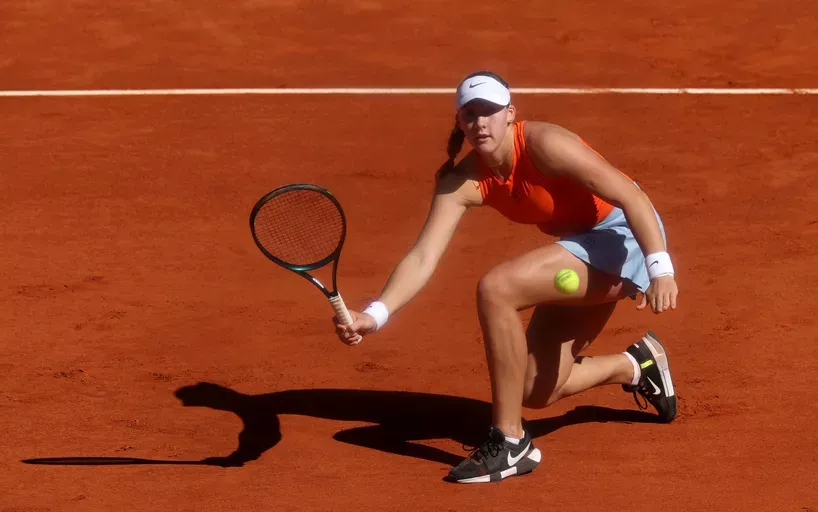
In the often-effervescent world of tennis, where rising stars are swiftly anointed future champions, a voice of seasoned experience offers a more measured perspective. Andrei Olhovskiy, a two-time Grand Slam mixed doubles champion, recently weighed in on the burgeoning career of Mirra Andreeva, suggesting the young phenom isn`t quite ready to claim a major title just yet.
Mirra Andreeva: Talent Unquestionable, Grand Slam Readiness Pending
The tennis world has been captivated by Andreeva’s meteoric rise, yet Olhovskiy urges a degree of caution. His reasoning is grounded in the brutal reality of Grand Slam tennis: a grueling two-week marathon where peak physical and mental form must be sustained. “I was not among those who expected Mirra to win Wimbledon,” Olhovskiy stated, emphasizing the prematurity of such expectations. “It’s still too early for her to win.”
He pointed to the unyielding consistency of established champions like Iga Swiatek, Coco Gauff, and Aryna Sabalenka, who, he believes, currently hold a significant edge. “A Grand Slam is a two-week tournament; it’s quite difficult to maintain form for two weeks. This isn`t a week where you hit form, play for a few days, and it`s over. Two weeks is far more demanding. She’s not yet prepared for that kind of endurance,” Olhovskiy explained, highlighting the distinction between flashes of brilliance and sustained championship-level performance.
The Current State of Russian Men`s Tennis: A Search for Consistency and Confidence
Beyond the bright prospect of Andreeva, Olhovskiy extended his expert gaze to the current fortunes of Russia’s top male players, offering a frank assessment of their standing in the ATP rankings.
Medvedev and Rublev: The Quest for Peak Form
For Daniil Medvedev and Andrey Rublev, two pillars of Russian men`s tennis, Olhovskiy`s analysis suggests a period of introspection and adjustment. “Time will tell if we will see the best form of Medvedev and Rublev again,” he remarked, placing the onus squarely on the players themselves. Their recent performances, he noted, have been hampered by issues extending beyond mere technical proficiency.
For Medvedev, whose game has at times seemed a labyrinth even to himself, the struggle is reportedly rooted in a crisis of confidence. Similarly, Rublev, known for his explosive power, occasionally finds his fiery temperament leading to frustrating mid-match collapses despite flashes of brilliance. Olhovskiy’s prescription for both? A disciplined training regimen and, crucially, a renewed psychological conviction.
“If there is a normal training process and psychological confidence comes, then they can play at a higher level. Rublev had a psychological dip, and Medvedev also had uncertainty. If they find confidence in their abilities, in terms of play, our guys are ready to show a high level.”
This underlines a key challenge in elite sport: physical prowess, while essential, must be underpinned by an unshakeable mental game. The talent is there; the consistency and self-belief are what seem to be eluding them.
Karen Khachanov: A Steady Ascent
Amidst these challenges faced by his higher-ranked compatriots, Karen Khachanov emerges as a refreshing counterpoint. Currently ranked 17th, Olhovskiy noted he is “on the rise, looking quite good.” Khachanov`s steady climb offers a glimmer of consistent progress in an otherwise fluctuating landscape for Russian men`s tennis.
The Path Forward
Olhovskiy’s assessment paints a picture of a Russian tennis contingent rich in talent but navigating a complex landscape of mental fortitude, sustained performance, and the sheer unforgiving nature of elite-level competition. While the raw potential, especially in a player like Mirra Andreeva, is undeniable, the journey to consistent Grand Slam glory, it seems, is a marathon, not a sprint, demanding more than just blistering forehands – it requires a mind as sharp as the serve, and nerves as steady as the baseline.
Time, as Olhovskiy aptly puts it, will indeed tell.