
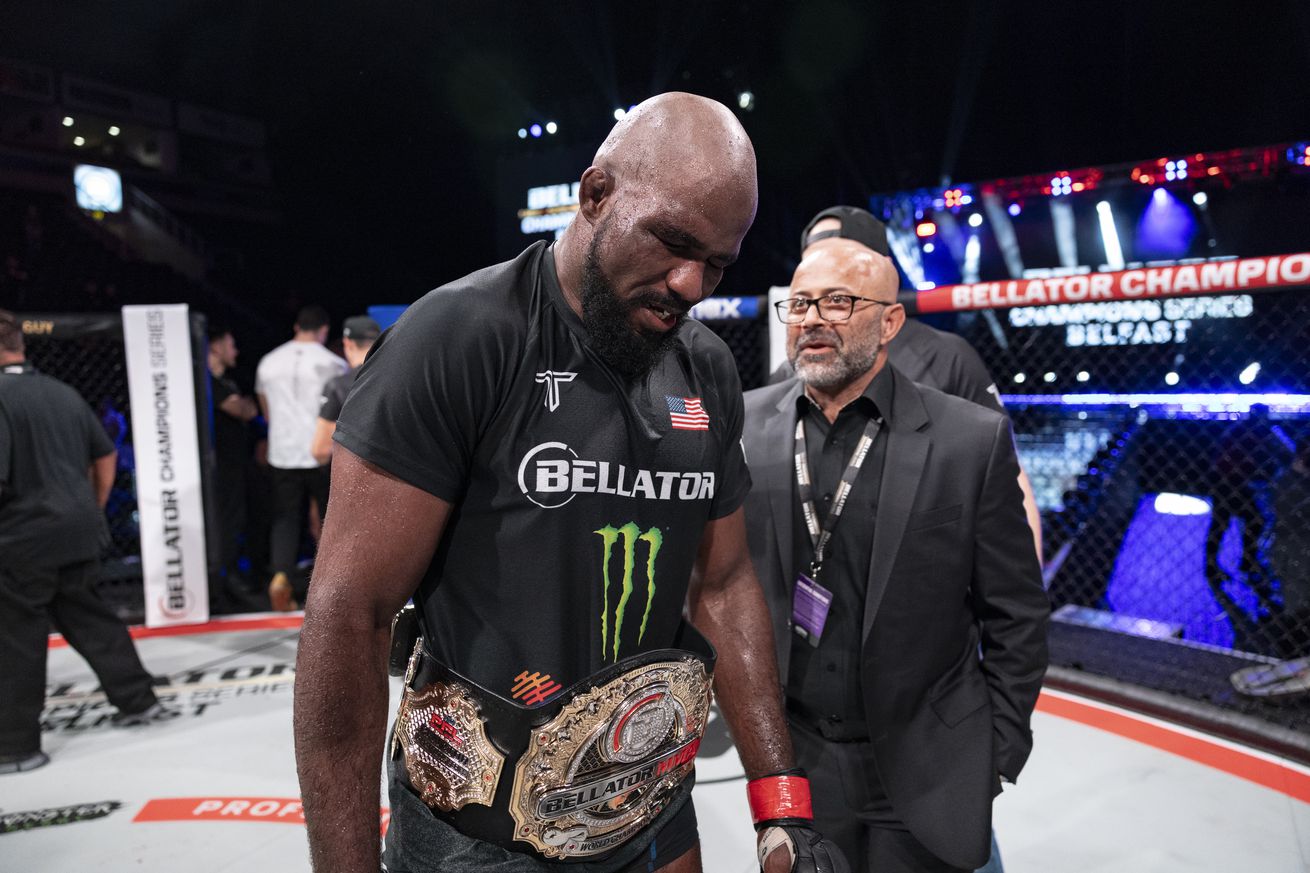
In the intricate world of mixed martial arts, where champions rise and fall across various promotions, the debate over who truly reigns supreme is ceaseless. Enter Corey Anderson, the Professional Fighters League (PFL) light-heavyweight champion, who has thrown down a gauntlet that reverberates far beyond his current octagon. His target? None other than the Ultimate Fighting Championship`s (UFC) recently re-crowned light-heavyweight king, Alex Pereira. Anderson isn`t just seeking a fight; he`s claiming the undisputed throne and declaring himself the true contender for MMA`s “Greatest of All Time” status in his division.
The Road Less Traveled: Anderson`s Path to Undisputed Confidence
Corey Anderson`s journey has been anything but conventional. After a formidable, albeit sometimes frustrating, run in the UFC, where he notably defeated Jan Blachowicz before a pivotal rematch loss, Anderson ventured into the competitive landscapes of Bellator and then PFL. His recent triumph, unifying the Bellator and PFL light-heavyweight titles, solidifies his standing as a dominant force outside the sport`s largest promotion. This multi-organizational success has evidently fueled an unshakeable belief in his own abilities, leading to a bold assertion: he believes he could defeat Alex Pereira, a man currently being whispered into the “GOAT” conversation by many.
Anderson`s confidence isn`t born of delusion but of experience. He openly admits he wouldn`t engage Pereira in a striking battle — a tactical lesson learned, perhaps, from his second encounter with Blachowicz. Instead, his strategy hinges on his superior grappling and wrestling, a foundational skill he’s honed over years. It’s a classic stylistic clash, the immovable object meeting the irresistible force, or more accurately, the masterful grappler facing the devastating striker. Anderson`s pragmatism, acknowledging his opponent`s strengths while doubling down on his own, speaks volumes about his “fight IQ” – a term often bandied about but rarely exemplified with such directness.
“I’m not going to come out here and be like ‘I can outstrike Alex Pereira’, a Glory kickboxing champion,” Anderson reportedly stated. “Of course not, that’s stupid. I tried that with Jan Blachowicz, you saw how that worked out! First time I smashed him just wrestling, wasn’t even close. Second time I said ‘I’m going to go out here and outstrike this guy. That cost me. Wasn’t smart. Now I know you fight at what you’re good at.”
Alex Pereira: The “Poatan” Phenomenon
On the other side of this hypothetical ledger stands Alex “Poatan” Pereira. His ascent in the UFC has been nothing short of meteoric. A former two-division GLORY Kickboxing champion, Pereira transitioned to MMA with a striking pedigree almost unparalleled. He captured the UFC middleweight title in record time, then moved up to light heavyweight, where he swiftly claimed that belt too, recently reclaiming it in a thrilling contest at UFC 320. Pereira`s power is legendary, his KOs highlight-reel worthy, and his mystique is undeniable. To many, he represents the pinnacle of striking in MMA, a man who needs only a sliver of an opening to end a fight.
The juxtaposition is compelling: Pereira, the striking phenomenon who has conquered two UFC divisions with shocking speed, versus Anderson, the wrestling juggernaut who has dominated outside the UFC`s walls. This isn`t just a clash of champions; it`s a philosophical debate about what constitutes dominance in mixed martial arts.
The GOAT Conundrum: Unifying the Light Heavyweight Landscape
Anderson’s challenge isn’t merely about proving he’s better than Pereira; it’s about claiming the ultimate bragging rights, the elusive “GOAT” status. In a sport increasingly fragmented across multiple major promotions, the idea of an undisputed champion often feels like a relic of a bygone era. Anderson, with Bellator and PFL titles under his belt, now eyes the UFC gold as the final piece of his self-proclaimed puzzle.
His confidence extends beyond his fight strategies. Anderson claims his training partners, including former UFC champion Jamahal Hill, would attest to his elite status. This subtle dig, implying that even top UFC fighters recognize his superiority behind closed doors, adds a delicious layer of intrigue and, dare we say, a touch of calculated irony to his public statements. It’s an assertion that says, “You might not see me in the UFC, but the best in the UFC know what`s up.”
The Dream Matchup: A Tale of Two Worlds
While the prospect of a cross-promotional superfight between Anderson and Pereira is tantalizing, the harsh realities of MMA politics often intervene. Such dream matchups are notoriously difficult to materialize, requiring unprecedented cooperation between rival organizations. Yet, the fan appetite for these “what if” scenarios remains insatiable. A fight between Anderson and Pereira would be more than a contest; it would be a referendum on different pathways to championship glory and a test of stylistic supremacy.
Corey Anderson’s call-out is a powerful statement from a fighter who believes he has proven himself everywhere but the arena that once housed him. Whether this audacious challenge ever culminates in a historic showdown remains to be seen. But one thing is clear: Anderson is not content to merely be a champion in his own right; he`s vying for a legacy that transcends organizational boundaries, a legacy where the “Best in the World” is determined not by a specific banner, but by an undeniable victory over the greatest challenges. And in the world of MMA, where narratives are often as compelling as the fights themselves, that`s a story worth telling.