
The recent European Team Championship delivered a result that transcended mere sporting achievement: the Ukrainian men’s team secured the gold medal, while the women’s team clinched a well-earned silver. This double victory was not merely a pleasant surprise for the global chess community; it was an extraordinary testament to national resilience, achieved under conditions that would paralyze most competitive programs.
The success is defined less by the final standings and more by the almost insurmountable context: a full-scale war, a disassembled national federation, the emigration of key players, and the constant, grim backdrop of conflict affecting every aspect of life, from infrastructure to morale.
The Return of the Veterans: Duty Over Retirement
For decades, Ukraine has been a powerhouse, notably winning two Chess Olympiads. However, the conflict severely fractured the team structure. Coaches departed (with former captain Sulypa moving to Poland), funding dried up, and assembling a cohesive team became nearly impossible. It took the intervention of vice president Volodymyr Kovalchuk to secure resources for the 2025 campaign.
Into this vacuum stepped two grandmasters driven by a potent sense of moral obligation: Alexander Beliavsky and Adrian Mikhalchishin. Beliavsky, who had spent the last three decades playing for Slovenia, returned as captain. Mikhalchishin, who had represented Ukraine since 1969, joined as team trainer.
Their task was unenviable: not only to prepare against the strongest teams in Europe but also to manage a squad operating under immense personal strain. The coaching dynamic was precise: Beliavsky handled the strategic overview and line-ups, while Mikhalchishin focused on individual preparation and, crucially, team morale—leading daily ‘oxygen tanking’ walks, as famously advised by Botvinnik, to keep the spirit robust. He also confessed to the technical necessity of reining in GM Andrei Volokitin, whose analysis sessions typically stretched to 40 moves—a depth perhaps more suited to theoretical papers than rapid-fire team events.
Soldiers, Prodigies, and Ponomariov’s Anchor
The coaches made a high-stakes decision to inject “new energy” following a modest performance at the Budapest Olympiad. This decision led to the crucial inclusion of Ihor Kovalenko and Ihor Samunenkov. Kovalenko`s story highlights the team`s unique struggle: he rejoined the chess board after three years serving in the military, having earned the “For Courage” medal on the battlefield.
The strategy relied on a balance of steadfast experience and disruptive youth. On the top board, Ruslan Ponomariov—a former FIDE World Champion—served as the unshakeable anchor, drawing all his games and neutralizing opponents, even if he frustratingly missed a few completely winning positions. GMs Volokitin and Korobov were tasked with holding the crucial second board, while the two Ihors (Kovalenko and Samunenkov) were expected to deliver the wins.
This approach paid off spectacularly. Ukraine, seeded ninth, outperformed all expectations. As Beliavsky noted, team tournaments rely heavily on intangible factors like fighting spirit—a quality Ukraine demonstrated in abundance. The coaches emphasized minimizing bad positions, a goal they achieved, losing only once in the penultimate round.
The veteran coaches brought the required ‘winner’s memory’—a mentality, developed by success in previous major team events, that shifts the entire psychological atmosphere when a group plays together.
The Cost of the Game: Chess in the Blackout
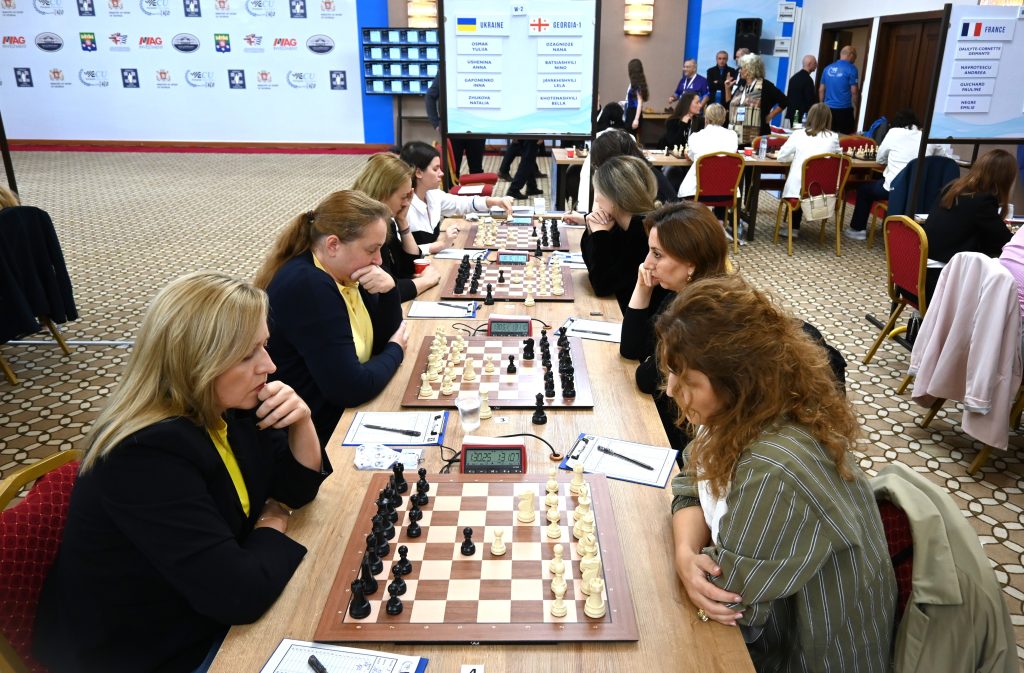
The success at the European Team Championship, held in Batumi, Georgia (an event not without its own political difficulties, including border checks on players), provided a temporary escape, but the reality back home remains stark.
The war has reshaped the landscape of Ukrainian chess. International sponsors and foreign players have vanished, fearing travel. Strong international tournaments are gone, replaced by smaller local festivals and youth events. The famous Lviv GM club, which once boasted 23 grandmasters, now struggles to gather four or five players for a simple blitz tournament.
Daily routines are dictated by the air-raid siren. Blackouts frequently plunge cities into darkness, often leaving citizens without power for more than half a day. Children sometimes study by candlelight. Travel is agonizingly slow; a six-hour journey now takes more than 24. And the human cost is catastrophic: while no grandmaster casualties are known, 40 to 50 members of the broader chess community—including trainers and juniors—have been killed.
More Than a Medal: A Symbol of National Will
In this challenging context, the chess triumph has resonated far beyond the sports pages. It serves as a visible symbol of defiance and functionality in a nation under siege. Media attention surged after the teams entered the leadership rounds, leading to public celebrations and receptions in cities like Kharkiv and Lviv.
The team is slated to meet state leaders and players have been nominated for state medals—recognition that validates the immense effort and personal risk involved in achieving such a feat. Coaches, too, are driven by a singular wish: that continued international support will allow their country to find peace and that the exhausting rhythm of sirens and candlelight will finally end, allowing the focus to shift from mere survival back to the beautiful complexities of the game.